Stay-in-Place Lubrication for Bearings, Assembly & Severe Contact
When liquid oils can't be effectively retained within a mechanical assembly, due to open structural designs, low operational speeds, intermittent motion, or sealing constraints, semi-solid tribological materials are required. This product group includes three distinct formulations: greases, pastes, and compounds.
Lubricating Greases
Structured semi-solid suspensions composed of a base oil immobilized within a 3D thickener matrix, formulated to bleed controlled amounts of lubricating oil into rolling elements and sliding interfaces over long service lives.
Lubricating Pastes
High-solid-content semi-solids, typically 15% to over 60% solid lubricants such as MoS2, copper, aluminum, or graphite, engineered for boundary lubrication under extreme press-fits, threaded connections, and slow sliding speeds.
Silicone / Dielectric Compounds
Non-melting formulations combining synthetic silicone fluids with inert thickeners, such as silica gel, designed primarily for moisture sealing, dielectric insulation, vacuum sealing, and valve lubrication rather than heavy anti-wear protection.
Grease is not simply thick oil. The thickener creates a structured matrix that retains base oil, responds to shear, and controls oil release and replenishment. In a rolling bearing, an initial churning phase redistributes grease away from the raceway. Pastes and compounds can contain far more solid material than a grease, providing high load capacity, anti-seize behavior, controlled assembly friction, and resistance to squeeze-out, but this can also make the product unsuitable for high-speed rolling bearings, fine centralized systems, or small clearances.
Compositional Architecture
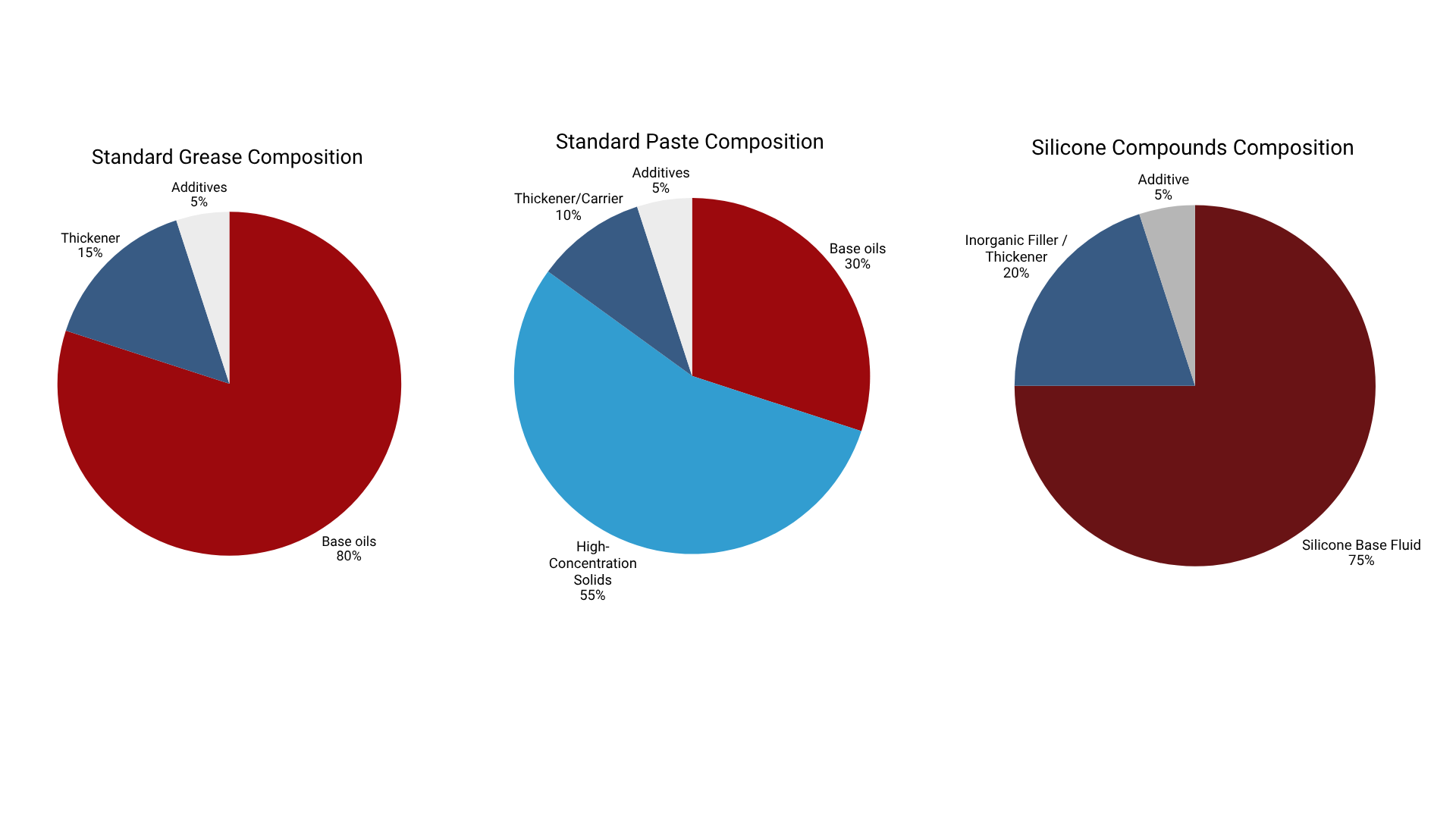
Standard Grease Composition
Base Oil (70–90%)
Mineral oils or synthetic fluids (like PAO or esters) that provide primary fluid lubrication.
Thickener (5–25%)
Metallic soaps, such as lithium, calcium, aluminum, or sodium complex soaps, that act like a sponge to hold the oil.
Additives (0–10%)
Rust inhibitors, anti-wear agents, and extreme-pressure (EP) additives.
Lubricating Paste Composition
Base Fluid (20–40%)
Mineral or synthetic lubricating oils.
High-Concentration Solids (40–60%)
Heavy loads of solid lubricants like graphite, molybdenum disulfide (MoS2), or PTFE.
Thickener/Carrier (10–20%)
Non-melting thickeners and dispersing agents designed to prevent the high volume of solids from settling out.
Additives (1–5%)
Surface adhesion promoters and extreme-pressure (EP) additives.
Silicone Compound / Grease Composition
Silicone Base Fluid (70–90%)
Polydimethylsiloxane (PDMS) or fluorosilicone oils providing strong thermal stability and water resistance.
Inorganic Filler / Thickener (5–20%)
Amorphous fumed silica creating a thixotropic, non-melting gel structure.
Performance Additives (0–5%)
Rust inhibitors, oxidation stabilizers, or extreme-pressure sulfur compounds added for enhanced metal protection.
Key Thickener Chemistries
Lithium 12-Hydroxystearate
The legacy standard. Max continuous temperature 120°C, with moderate water resistance.
Lithium Complex
High dropping point (>260°C) with strong high-temperature shear stability. The standard for automotive wheel bearings and general industrial motors.
Calcium Sulfonate Complex
Strong inherent extreme-pressure (EP) capacity and rust protection without additional chemical additives, and largely resistant to water wash-out. Common in mining, marine, and steel continuous-caster applications.
Polyurea (Non-Soap)
An organic polymer thickener containing zero metallic ash, with strong oxidation resistance and long life. A common choice for sealed-for-life, high-speed electric motor bearings.
PTFE (Fluorocarbon)
Used to thicken PFPE base oils. Resistant to most chemicals, solvents, and oxygen, and non-melting. Used in semiconductor vacuum pumps and extreme oven cart bearings above 280°C.
Thickener Compatibility Warning: Polyurea is strictly incompatible with lithium complex thickeners; mixing them causes matrix collapse and oil run-out. Old grease should always be fully purged before switching thickener chemistry.
NLGI Consistency Grades & ASTM D217
NLGI consistency grades classify the relative stiffness or hardness of lubricating greases, which determines fluid flow, pumpability, and sealability under operating conditions. The NLGI grading system uses a scale from 000 (fluid/semi-fluid) to 6 (very hard block grease). These grades are determined by measuring how far a standardized weighted cone penetrates the grease under the ASTM D217 test method.
| NLGI Grade |
Worked Penetration @ 25°C (10⁻¹ mm) |
Appearance / Consistency |
Primary Industrial Applications |
| 000 |
445–475 |
Fluid liquid |
Enclosed slow-speed gearboxes, centralized lube lines. |
| 00 |
400–430 |
Semi-fluid liquid |
Truck wheel hubs, agricultural gearboxes. |
| 0 |
355–385 |
Very soft semi-solid |
Centralized lube systems in cold ambient conditions. |
| 1 |
310–340 |
Soft semi-solid |
Heavy-duty industrial bearings, outdoor pump stations. |
| 2 |
265–295 |
Normal grease (butter-like) |
Standard electric motor bearings, general automotive bearings. |
| 3 |
220–250 |
Firm semi-solid |
Vertical shaft bearings, high-vibration applications. |
| 4 |
175–205 |
Very firm |
High-speed anti-friction bearings, enclosed gearboxes. |
| 5 |
130–160 |
Very hard |
High-temperature static or slow-moving seals, plug cocks, large industrial valve stems. |
| 6 |
85–115 |
Solid block |
Specialized sliding surfaces, heavy-duty sliding block guides. |
.png)
Lubricating Mechanism
Rheological Behavior & Thixotropic Shear Dynamics
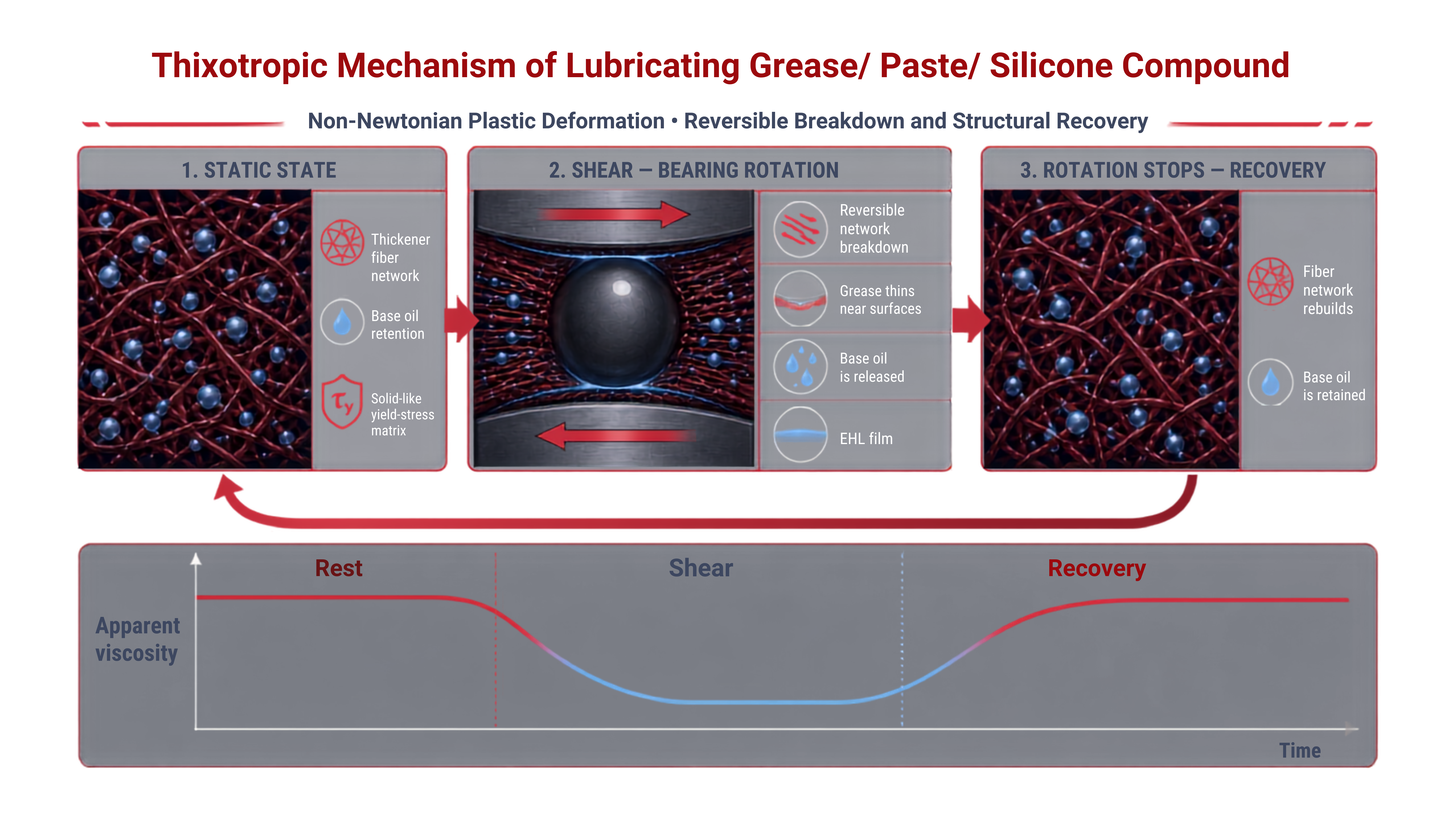
Greases operate as non-Newtonian, thixotropic plastic materials. At rest, the soap or polymer thickener fiber network forms a solid-like matrix defined by a specific yield stress that holds the base oil in suspension.
Upon application of mechanical shear from rotating bearing elements, this structural network breaks down reversibly in the contact zone. This localized shear-thinning action reduces fluid viscosity, releasing free base oil into the rolling track to form a protective elastohydrodynamic (EHL) film. Once mechanical shear forces cease, the thickener fiber network recombines, re-immobilizing the remaining base oil within the matrix.
The Bearing Lubrication Lifecycle
Initial Churning Phase
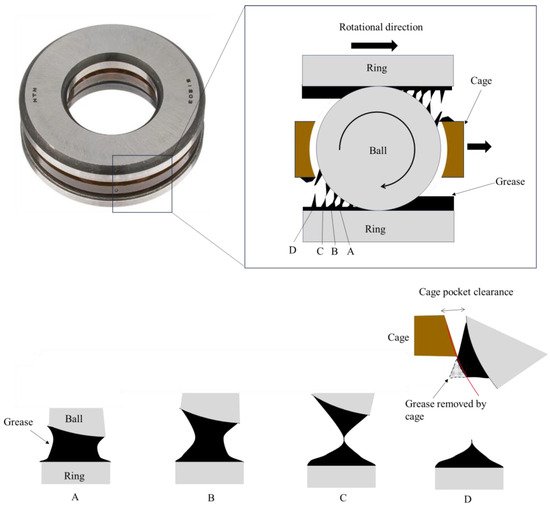
In a newly greased rolling bearing, the rolling elements push and shear the bulk grease. This phase produces high internal friction and redistributes excess grease into side housing reservoirs.
→
Channeling & Bleeding
Once the bearing settles, the contact operates with a limited lubricant supply. Continuous film maintenance relies on controlled bleeding of base oil from the adjacent side reservoir grease.
→
Film Formation
The released oil forms a separating film within the contact area. If the film is incomplete (Film Thickness Ratio Λ < 1), anti-wear (AW) additives and dispersed solids protect the surface through tribochemical layers. When rotation stops, the thickener network recombines.
Pros and Cons of Semi-Solid Lubrication
| Advantages |
Disadvantages & Limitations |
- Leakage Prevention: Stays exactly where applied; doesn't require complex oil seals or circulating pumps.
- Contaminant Sealing: Forms a physical barrier (grease collar) at the bearing edges, blocking dust, dirt, and water ingress.
- Stop-Start Protection: Retains a solid lubricating film on bearing surfaces even during extended downtime, preventing dry-start wear.
|
- Poor Heat Dissipation: Unlike circulating oil, grease can't carry frictional heat away from the contact zone.
- Debris Trapping: Wear particles and external contaminants are held within the grease matrix rather than being flushed away.
- Speed Limitations: High rotational speeds (high DN factors) cause severe grease churning, leading to rapid thermal degradation and thickener collapse.
|
Product Selection Decision Tree
| Operating Parameter |
Primary Selection Recommendation |
Key Specification Requirement |
| Standard ball/roller bearings (<120°C, moderate load) |
NLGI 2 lithium complex lube grease |
ISO VG 100–220 base oil, AW additive package. |
| Heavy mining / crusher bearings (high shock load) |
Calcium sulfonate complex grease with 3–5% MoS2 |
ISO VG 460 base oil, high Timken OK load (>60 lbs). |
| Electric motor bearings (high speed, low shear loss) |
Polyurea thickener grease |
NLGI 2, low base oil viscosity (ISO VG 100), long oxidation life. |
| Assembly press-fits / splines (high interference pressure) |
MoS2 assembly paste (>50% solid) |
Carrier fluid burns off cleanly; metallic solids prevent cold welding. |
| Threaded fasteners / stainless steel flanges (>500°C) |
Nickel / graphite anti-seize paste |
Zero lead/sulfur, high solid metallic filler content. |
| Electrical connectors / O-ring rubber assembly |
Silicone dielectric compound |
High dielectric strength (>30 kV/mm), inert and non-swelling. |
Key Application Sectors & Machinery Components
Electric Motor & Industrial Pump Bearings (Greases)
Mechanism: High speeds and moderate-to-high temperatures (80°C–150°C), requiring long-term operational life without oil leakage into motor windings.
Role: Polyurea-thickened NLGI 2 greases with synthetic PAO base oils offer long shear stability, low thickener hardening, and low noise, extending relubrication intervals to over 15,000 operating hours in many applications.
Heavy Mining, Cement, & Construction Equipment (High-Load Greases)
Mechanism: Extreme shock loading, heavy vibration, dust contamination, and water wash-off in jaw crushers, excavator bucket pins, vibrating screens, and slewing rings.
Role: Heavy-duty calcium sulfonate complex or lithium complex greases enriched with 3% to 5% solid MoS2 (NLGI 1 or 2, ISO VG 460 base oil). The thickener provides inherent rust protection and water resistance, while MoS2 helps prevent pin galling during high shock impacts.
Threaded Connections, Flanges, & Turbines (Anti-Seize Pastes)
Mechanism: Extreme thermal exposure (roughly 300°C to 1,000°C), aggressive atmospheric corrosion, and high torque loading leading to thread galling and cold welding.
Role: Metallic pastes containing high solid concentrations (copper, nickel, aluminum, or calcium fluoride powder in a low-viscosity carrier). When the carrier oil evaporates at high temperatures, the metal powders form a mechanical barrier, supporting predictable break-away torque during maintenance turnarounds.
Assembly Press-Fits, Splines, & Keyways (Assembly Pastes)
Mechanism: High contact pressures during mechanical press-fitting of bearings, gears, and bushings onto shafts, causing stick-slip, fretting corrosion, and surface scoring.
Role: High-concentration molybdenum disulfide pastes (>50% MoS2). The solid particles burnish into metal micro-roughness, helping prevent galling during press assembly and reducing fretting corrosion during operational micro-oscillations.
Electrical Switchgear, Spark Plug Boots, & Seals (Silicone/Dielectric Compounds)
Mechanism: Electrical arcing, moisture intrusion, corona discharge, and rubber elastomer hardening or swelling.
Role: Inert polydimethylsiloxane (PDMS) silicone fluids thickened with amorphous silica. These compounds don't melt, offer strong dielectric strength (>30 kV/mm), seal out moisture, and lubricate O-rings and plastic components without causing elastomer swelling.


