What is a surface treatment?
Surface treatments are a broad category of techniques used to alter the surface properties of a material. They are used to improve the performance, durability and longevity of products by providing protection against wear, corrosion and other types of damage. Surface treatments can be divided into three main categories: mechanical, thermal and chemical treatments.
Mechanical surface treatments
Mechanical surface treatments include techniques such as grinding, honing, polishing, and sandblasting. These processes use mechanical energy to remove material from the surface and improve the surface finish. They can also be used to create specific microstructures that improve the material's properties.
Thermal surface treatments
Thermal surface treatments include techniques such as heat treatment, annealing, and quenching. These processes use heat to alter the material's properties. Heat treatment is used to change the microstructure of a material and improve its strength and ductility. Annealing is used to relieve internal stresses in a material, while quenching is used to harden a material by rapidly cooling it.
Chemical surface treatments
Chemical surface treatments include techniques such as electroplating, anodizing, and painting. These processes use chemicals to alter the surface properties of a material. Electroplating is used to deposit a thin layer of a different metal on the surface of a material, while anodizing is used to create a hard, corrosion-resistant oxide layer on the surface of aluminum and titanium. Painting is used to protect the surface from corrosion and to improve its appearance.
Aculon Surface Treatments are a specific type of chemical surface treatment that uses nanoparticles to coat a surface, improving the properties of the product, creating a barrier that is highly resistant to water, oils and other liquids. Aculon Surface Treatments are typically made from nanoparticles and are designed to be hydrophobic, oleophobic, and/or anti-fouling. They can be used to improve the performance of various products, such as electronics, textiles, and industrial equipment.
To conclude, surface treatments are a crucial step in enhancing the properties of various products. They can be applied to a wide range of surfaces, including metal, plastic, glass, and ceramic, and provide benefits such as improved durability and longevity, protection against wear and corrosion, and improved performance of products. Aculon Surface Treatments is a specific type of surface treatment that utilizes nanoparticles to create a conformal coating, which provides protection against water, oils and other liquids.
Self Assembled Monolayer Phosphonates
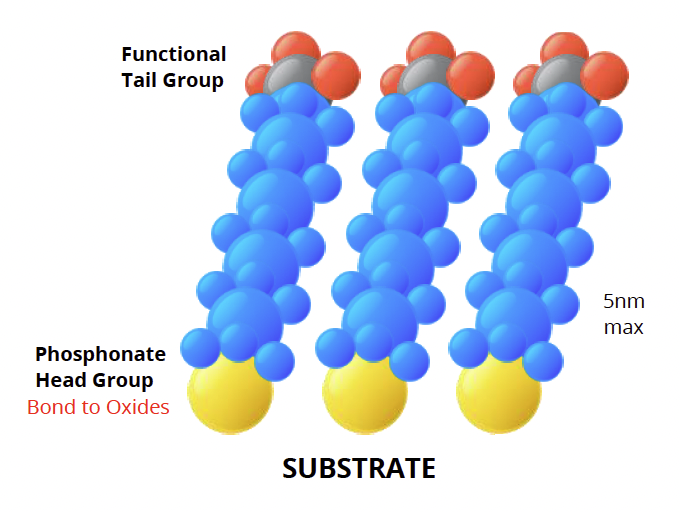
Our proprietary “Self Assembled Monolayer of Phosphonates” (SAMP) can treat surfaces to impart repellency.
The SAMP monoloayer is comprised of a phosphonic acid and a repellent, carbon-based molecule:
- Phosphonic acid reacts with the surface and creates a covalent bond at the substrate: phosphonic acid interface
- The carbon group connected to the phosphonic acid is the functional mono layer
- The monolayer is less than 5 nanometers thick
Multiple surface treatments are available:
- Hydrophilic
- Hydrophobic
- Super hydrophobic
- Oleophobic

Unlocking Advanced Surface Properties with Nanoparticle-Based Chemical Surface Treatments
Chemical surface treatments that use nanoparticles are becoming increasingly popular in a variety of industries due to their ability to provide advanced surface properties. These treatments use nanoparticles to modify the surface of a material, creating a thin, uniform layer that can improve the material's physical, chemical, and electrical properties.
One of the main benefits of using nanoparticles in chemical surface treatments is that they can provide a high level of control over the surface properties of a material. This allows manufacturers to create surfaces that are highly hydrophobic or hydrophilic, conductive or insulating, or resistant to corrosion, among other properties.
Nanoparticle-based surface treatments can also be applied to a wide range of materials, including metals, plastics, ceramics, and composites. This makes them useful in a variety of industries, including electronics, aerospace, automotive, and medical devices. In addition to providing advanced surface properties, nanoparticles used in chemical surface treatments can also offer environmental benefits. For example, some treatments use nanoparticles that are free from hazardous chemicals, making them safer and more sustainable than traditional surface treatment methods.
Overall, chemical surface treatments that use nanoparticles offer a versatile and effective way to modify the properties of a material's surface. With their ability to improve performance, durability, and sustainability, these treatments are likely to become increasingly important in many industries in the years to come.
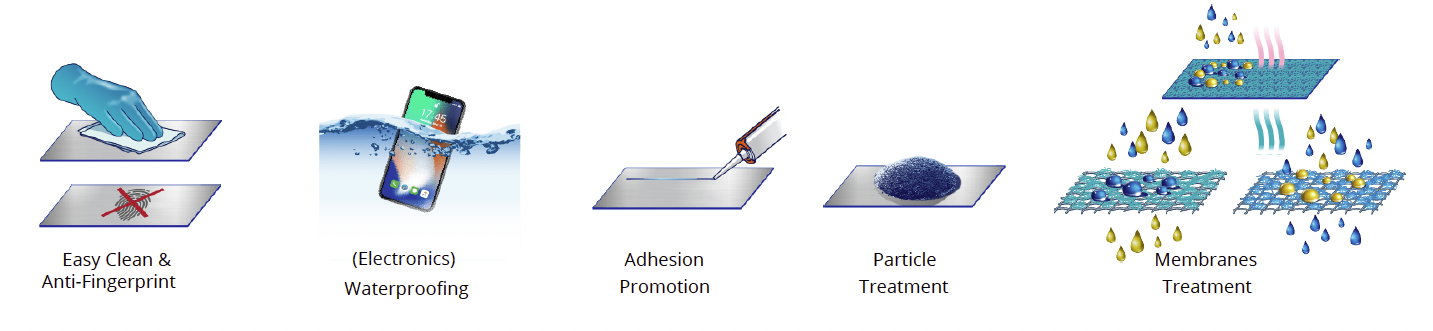
These surface treatments can practically be used for the following applications:
- Anti-fingerprint
- Waterproofing
- Adhesion promotion
- Particle treatment
- Membrane treatment
All these treatments are quite versatile and depending on the process parameters such as concentrations, solvents, temperature and coverage they can either be dipped, sprayed or wiped.
Presentations
Surface Treatments
This presentation provides an introduction to surface treatment technologies used to improve material performance and durability. It covers common surface preparation and modification methods, their effects on adhesion, corrosion resistance, wear protection, and surface energy, and how selecting the appropriate treatment enhances bonding reliability and long-term performance across industrial and electronics applications.