Classification of Silicone Adhesives by Vulcanization Profile
Silicone adhesives are categorized fundamentally by their stoichiometric packaging (1K vs. 2K) and their specific thermodynamic vulcanization mechanisms. This dictates their curing kinetics, process compatibility, and required environmental triggers.
1. RTV (Room Temperature Vulcanizing) – 1K Systems
These single-component, pre-catalyzed systems rely exclusively on a condensation cure mechanism. They utilize ambient atmospheric humidity to trigger the hydrolysis of highly reactive silane end-groups, forming transient silanols that subsequently condense to form the Si-O-Si crosslinked network. Because the reaction front moves from the exterior surface inward, these systems are constrained by a strict depth-of-cure limit (typically 6–10 mm). They are sub-classified by the molecular leaving group (byproduct) evolved during this reaction.
Acetoxy-Cure
Pros: Rapid skin-over time and high initial modulus.
Cons: Evolves acetic acid, which is highly corrosive to sensitive metals (copper, brass, zinc) and can cause stress-cracking in polycarbonates.
Neutral-Cure (Alkoxy)
Pros: Non-corrosive, low volumetric shrinkage; industry standard for microelectronics, bare-die encapsulation, and PCB component staking.
Cons: Evolves alcohols (methanol or ethanol); slower reaction kinetics than acetoxy due to steric hindrance of the alkoxy groups.
Neutral-Cure (Oxime)
Pros: Evolves ketoximes (e.g., MEKO); faster tack-free time than alkoxy while remaining non-corrosive; aggressive primerless adhesion to LSE substrates and unpainted metals.
Cons: MEKO outgassing carries regulatory/toxicity concerns.
Effect of Humidity and Temperature on Curing Speed & Depth of 1K-RTV Silicone Adhesive
For 1K RTV systems, the primary driver is relative humidity (RH). The core rule of thumb is that the higher the relative humidity, the faster the curing rate. If RH drops below 5%, curing may stop completely. Thermal input has only a minor effect on skin-forming and overall curing speed.
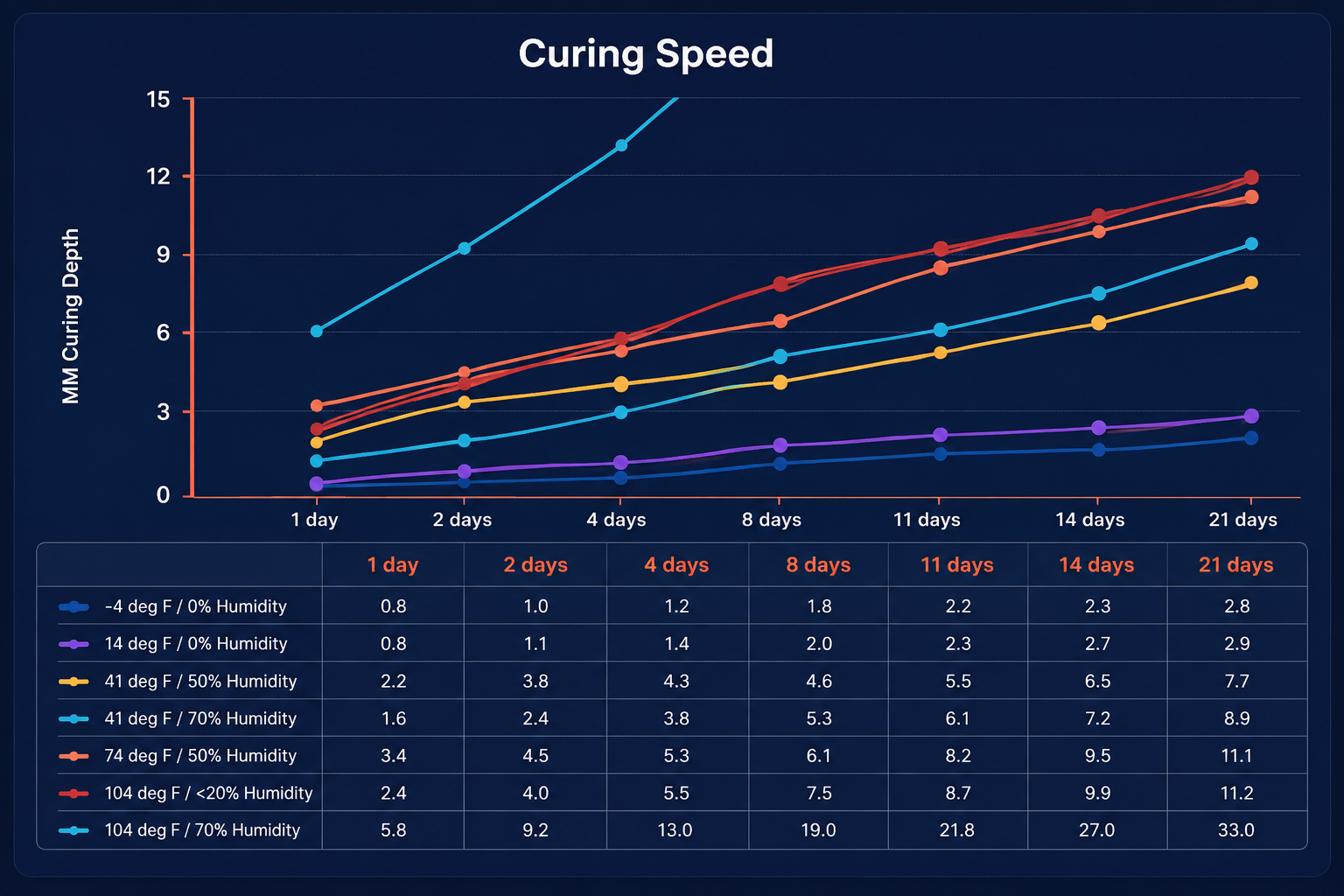
According to the effect of humidity and temperature on curing speed and curing depth chart, curing depth can increase 2–3x when humidity increases from low (<20% RH) to high (70% RH) at the same temperature. Example at 104°F: 70% RH → 33.0 mm (21 days) and <20% RH → 11.2 mm (21 days). Higher temperature speeds up the reaction and increases the ultimate curing depth, but the effect is smaller than that of humidity.
2. RTV (Room Temperature Vulcanizing) – 2K Systems
Two-component systems segregate the polymer base (Component A) from the crosslinker/catalyst (Component B). Because the moisture required for proper curing is already included in the base compound, this eliminates the dependency on atmospheric moisture diffusion, allowing for infinite depth-of-cure in confined or deep-section geometries.
2K Condensation Cure
Utilizes an organometallic catalyst (frequently organotin compounds like dibutyltin dilaurate or titanates) to drive the condensation of a silanol-terminated PDMS base with a polyalkoxysilane crosslinker.
- Depending on the grade, mixing ratios of A:B vary broadly from 1:1 up to 100:1. Self-adhesive grades typically require an 8:1 to 12:1 ratio.
- As the system crosslinks, alcohol is released as a byproduct, leading to a dimensional shrinkage of <3% by volume.
- Curing can be slightly accelerated by heat, but temperatures must not exceed 80°C before the process is complete; exceeding this threshold reverses the crosslinking reaction due to trapped byproducts, causing the material to revert to a soft or tacky state.
- Condensation-curing silicones generally exhibit a high compression set.
2K Addition Cure (Platinum Catalyzed)
Operates via hydrosilylation. A transition-metal platinum complex catalyzes the addition of multi-functional silicon hydride (Si-H) crosslinkers across vinyl-terminated siloxane polymers.
- Components are typically mixed at specific volumetric ratios of 1:1, 9:1, or 10:1 by weight. Modifying this ratio can lead to incomplete curing or significant property degradation.
- The vulcanization rate is highly temperature-dependent; as a general rule, a temperature change of approximately 10°C will either halve or double the pot life and curing speed. Shrinkage is virtually non-existent (<0.1%).
- Addition-curing grades show highly resilient properties with compression set values typically below 20%.
- The platinum catalyst is highly sensitive. Curing can be permanently inhibited by sulfur compounds (e.g., natural rubbers, EPDM), amines (e.g., polyurethanes, epoxy resins), organotin compounds (e.g., condensation RTV-2 catalysts), and various oils or plasticizers.
3. UV-Curable / Dual-Cure Systems
Utilizes photo-initiators (either free-radical generation for acrylated/methacrylated siloxanes, or cationic systems) to achieve instantaneous surface or line-of-sight crosslinking upon exposure to specific UV wavelengths (e.g., 365nm or 395nm). Many UV silicones incorporate a secondary "shadow cure" mechanism, typically a secondary moisture-condensation pathway, to ensure complete vulcanization in opaque or undercut regions where photons cannot penetrate.
4. HTV (High-Temperature Vulcanizing) Systems
HTV silicones (often supplied as High Consistency Rubbers [HCR] or certain Liquid Silicone Rubbers [LSR]) require significant thermal activation energy to initiate crosslinking, making them ideal for high-volume injection molding, extrusion, or calendering.
Peroxide Cure (Free Radical): Utilizes organic peroxides (e.g., dicumyl peroxide). Thermal input homolytically cleaves the peroxide into free radicals, which abstract protons from the methyl groups on the siloxane chain, creating highly stable carbon-carbon (C-C) crosslinks. This process leaves behind acidic breakdown products, strictly requiring a high-temperature post-cure bake to volatilize these residues and stabilize the elastomer's physical properties.
Addition Cure (Thermal-Pt): Relies on the same vinyl/Si-H hydrosilylation chemistry as 2K RTVs, but incorporates specialized latency inhibitors (such as acetylenic alcohols). These inhibitors block the platinum catalyst at room temperature, providing exceptionally long pot lives. Upon reaching the activation temperature (typically between 130°C and 200°C), the inhibitor volatilizes or dissociates, allowing the platinum to trigger a rapid, high-speed cure.
Comparison of Silicone Adhesive Vulcanization Systems
.png)
| System Architecture |
Crosslink Mechanism |
Leaving Group / Byproduct |
Volumetric Shrinkage |
Key Engineering Advantage |
Primary Limitation / Risk |
| 1K RTV Acetoxy |
Condensation (Moisture) |
Acetic Acid |
Moderate (~3–5%) |
High green-strength; rapid skin-over |
Corrosive to sensitive metals and specific plastics |
| 1K RTV Alkoxy |
Condensation (Moisture) |
Methanol / Ethanol |
Low (~2–3%) |
100% non-corrosive; excellent dielectric properties |
Slower cure kinetics; limited depth of cure |
| 1K RTV Oxime |
Condensation (Moisture) |
Ketoximes (e.g., MEKO) |
Moderate (~3–5%) |
Aggressive primerless adhesion |
MEKO outgassing has regulatory/toxicity concerns |
| 2K RTV Condensation |
Condensation (Organotin) |
Alcohols |
Low (~1–2%) |
Infinite depth of cure; robust processing |
Prone to reversion if heated in confined spaces |
| 2K RTV Addition (Pt) |
Hydrosilylation (Pt) |
None |
Near-zero (<0.1%) |
Zero outgassing; exceptional dimensional stability |
Highly susceptible to severe catalyst poisoning |
| UV / Dual-Cure |
Free Radical / Cationic |
None (during UV phase) |
Low (~1–3%) |
"Cure-on-demand" instantaneous fixturing |
Requires optical clearance; expensive equipment |
| HTV Peroxide |
Homolytic Free Radical |
Volatile organic acids |
Moderate (~3–6%) |
Extremely robust mechanical and tear strength |
Mandates intensive post-cure baking protocols |
| HTV Thermal Addition |
Hydrosilylation (Pt) |
None |
Near-zero (<0.1%) |
Ultra-fast thermal cure; clean processing |
Requires high thermal input; Pt-poisoning risk |
Silicone Key Features and Benefits
The fundamental performance of silicone adhesives stems directly from their highly stable polysiloxane polymer backbone. Unlike traditional organic adhesives based on carbon-carbon (C-C) backbones, silicones are characterized by fully saturated, alternating silicon and oxygen atoms. This unique chemistry dictates their physical behavior and operational limits.
Extreme Bond Energy (Thermodynamic Stability)
The silicon-oxygen (Si-O) linkages in the polymer chain possess an exceptionally high bond energy of 451 kJ/mol, significantly higher than the 352 kJ/mol bond energy of standard C-C links. This grants outstanding long-term thermal stability, maintaining constant physical properties across a continuous operational range of -50°C to +180°C. Specialty formulated grades can retain low-temperature flexibility down to -110°C or withstand high-temperature peaks up to +270°C.
High Chain Mobility & Low Young's Modulus
The Si-O siloxane backbone exhibits very high chain mobility, which inherently gives the cured elastomer a low Young's modulus. This provides long-lasting elastomeric flexibility and stress relaxation. The adhesive distributes mechanical strain over the entire bonding area, compensating for thermo-mechanical loads when bonding dissimilar substrates with mismatched coefficients of thermal expansion (CTE).
Shielded Backbone (Low Surface Energy)
Organic side groups (such as methyl or vinyl groups) covalently bonded to the silicon atoms shield the inorganic backbone, resulting in very low surface energy. This creates a highly water-repellent surface paired with extraordinarily low moisture uptake, and grants superior resistance to aggressive environmental factors, including prolonged exposure to UV radiation, ozone, and weathering.
Inherent Dielectric Inertness
Siloxanes are fundamentally non-conductive, boasting a high breakdown voltage ranging from 20 kV/mm to over 100 kV/mm. They deliver outstanding dielectric properties that remain remarkably constant over a broad spectrum of extreme temperatures and frequencies. In structural applications, this electrical insulation prevents galvanic corrosion when bonding dissimilar metals.
Chemical Purity & Physiological Inertness
Compared to highly formulated organic elastomers, silicones require very few additives and are exceptionally pure. This high chemical purity guarantees biocompatibility and physiological tolerance. They are odorless, tasteless, and do not outgas harmful toxic compounds, making specific grades strictly compliant with FDA, BfR, and ISO 10993 standards for medical, food, and sensitive semiconductor applications.
Chemical Compatibility and Catalyst Inhibition in Addition-Cure Systems
1. Symptoms
Cure inhibition is generally localized to the interface where the addition-curing RTV silicone meets the contaminated substrate, though severe contamination can affect the bulk mass. Symptoms of an incompatible substrate include:
- Permanent surface tackiness or a completely unreacted, liquid boundary layer at the substrate interface.
- Significantly delayed vulcanization kinetics, or failure to crosslink even under elevated thermal input.
2. Chemical Inhibitors (Catalyst Poisons)
Inhibition occurs when electron-donating ligands in the contaminant form stable coordination complexes with the platinum center, physically blocking it from catalyzing the hydrosilylation of the vinyl and Si-H groups.
| Compounds containing nitrogen |
Amines and amides: neutralizing amines, ethanolamine, N-methylethanolamine, triethanolamine, N,N-dimethyl ethanolamine, n-butylamine, diethylamine, triethylamine, tetramethylenediamine, cyclohexylamine, melamine, dimethylformamide.
Nitriles, cyanates, oximo, nitroso, hydrazo, azo compounds: adiponitrile, 2-butoxime, alpha-nitroso-beta-naphthol.
Chelates: EDTA (ethylenediaminetetraacetic acid), NTA (nitriloacetic acid). |
| Compounds containing sulfur |
Sulfides, thio compounds: dibenzyldisulfide, thioacetic acid, allylthiourea. |
| Compounds containing tin |
Fatty acid tin salts, such as those used in tin-catalyzed silicone release coatings. |
| Compounds containing phosphorus |
Phosphines: triphenylphosphine.
Phosphites: triethylphosphite. |
| Compounds containing arsenic, antimony, selenium, tellurium |
Arsines, stibenes, selenide, telluride: triphenylarsine, triphenylstibene, p-chlorophenylcarboxymethylselenide. |
| Residual solvent or monomers |
Chlorinated hydrocarbons that contain amine stabilizers.
Alcohols: ethanol, methanol.
Esters: ethyl acetate, vinyl acetate.
Compounds with unsaturated bonds. |
| Residual solvents that do not inhibit cure |
Nonchlorinated aromatic and aliphatic solvents: toluene, xylene, hexane, mineral spirits. |
| Primers that may inhibit cure |
Polyethylene with anti-slip, antioxidant, or other additives listed above; primers with pigments containing compounds listed above; 100% sodium salt primers, such as sodium alginate or carboxymethylcellulose sodium salt (however, if these salts are used with hydroxyethylcellulose, inhibition will not occur); clay coatings using polyvinylacetate or acrylic latex as a binder; coatings containing calcium carbonate; coatings composed of natural rubber latex/clay, latex/ethylated starch, styrene/acrylic, or polyvinylacetate/polyvinylacetate-acrylic combinations. |
| Primers that do not inhibit cure |
Polyvinylalcohol; polyvinylalcohol/alginate; ethylcellulose; hydroxyethylcellulose/alginate; hydroxyethylcellulose/carboxymethylcellulose; clay/S.B.R. coatings. |
3. Hidden Sources of Contamination
Dispensing and Mixing Equipment: Residual traces of organotin catalysts or amine-cured epoxies inside shared metering lines or static mixers.
Vapor-Phase Poisoning: Shared post-curing ovens or drying cabinets that previously housed organic rubbers or casting resins can outgas amine or sulfur vapors, inhibiting the silicone as it cures in the same airspace.
4. Engineering Mitigation and Process Control
To ensure robust crosslinking and reliable adhesion, compatibility must be managed through strict process controls:
- Patch Testing: If a substrate's chemical profile is unknown, preliminary small-scale compatibility trials are strictly recommended before full production.
- Surface Preparation: Physical cleaning using low-boiling, non-polar, grease-dissolving solvents (e.g., isopropanol, aliphatic solvents) to strip migratory plasticizers and surface oils.
- Chemical Modification (Catalyst Boosting): In boundary-case scenarios where trace inhibitors cannot be entirely removed, the formulation's robustness can be increased by adding a catalyst booster. Adding up to 0.25 wt.% introduces an excess of active platinum to overwhelm trace contaminants and drive the cure to completion.
Dow Electronics Protection & Assembly Academy – Lab Series – Inhibition
A video demonstration of how to test for material compatibility and cure inhibition with addition cure silicone products: videos.dow.com/view/M25307
Thermal Reversion in Condensation-Curing Silicones
1. The Chemical Mechanism of Reversion
Condensation-curing systems (both 1K and 2K) crosslink by forming Si-O-Si bonds while simultaneously cleaving off volatile leaving groups, such as alcohols, amines, oximes, or acetic acid. Because this is a reversible equilibrium reaction, the stability of the polymer network depends entirely on the successful outgassing of these byproducts.
If a condensation-cured silicone is permanently confined in a deeply sealed, unventilated assembly, these volatile byproducts become physically trapped within the elastomer matrix. When this confined system is subjected to elevated temperatures, specifically exceeding 90°C, the trapped volatiles attack the polymer backbone. Furthermore, at extreme thermal loads exceeding 200°C, any trace atmospheric moisture or free hydroxyl groups residing on the surface of internal silica fillers can also trigger the hydrolytic cleavage of the Si-O bonds.
2. Macroscopic Symptoms of Failure
When reversion occurs, the elastomer loses its structural integrity. The physical symptoms include:
- A permanent decrease in Shore hardness (severe softening).
- The elastomer reverting from a solid, resilient rubber back into a sticky, putty-like, or semi-liquid state.
- A catastrophic drop in mechanical properties (tensile strength, tear resistance) and a compression set approaching 100% (complete loss of elastic memory).
3. Engineering Mitigations and Process Controls
Preventing reversion requires rigorous thermodynamic and mechanical design controls to ensure the equilibrium reaction favors polymer stability rather than depolymerization.
- Atmospheric Oxygen and Ventilation: The reversion process is fundamentally inhibited by the presence of atmospheric air. Therefore, high heat resistance in condensation silicones strictly requires unrestricted access to atmospheric oxygen. Gasket geometries and potting housings must be designed to allow continuous outgassing.
- Thermal Post-Treatment (Baking): To stabilize the elastomer before it enters service, it is highly recommended to perform a controlled post-cure to drive off the byproducts. The freshly cured vulcanizate should be stored open (maximizing surface area exposure) and aged.
- Room Temperature Aging: Approximately 24 hours per cm of thickness to the nearest exposed surface.
- Thermal Aging: Approximately 6 hours per cm of thickness at a maximum temperature of 70°C. Heating the elastomer above 80°C before the byproducts have escaped will immediately induce reversion.
- System Substitution: If the application strictly demands a deeply confined, unventilated assembly (e.g., a completely sealed electronic housing) that will be subjected to high operating temperatures, condensation-curing silicones must be engineered out of the design. 2K addition-cure (platinum) silicones must be specified instead, as they operate via hydrosilylation, yield zero volatile byproducts, and thus carry zero risk of chemical reversion at elevated temperatures.
Storage Kinetics and Shelf Life Management
Shelf Life
Depending on the specific elastomer grade, silicone adhesives generally exhibit a shelf life ranging from 3 to 24 months from the date of delivery.
Storage Conditions
Materials must be stored in their original, tightly closed containers in a dry environment, with ambient temperatures maintained between 5°C and 30°C. Prolonged exposure to average temperatures exceeding 30°C will thermodynamically accelerate material aging and significantly shorten shelf life. Containers must not be exposed to direct sunlight, and care must be taken to prevent particulate contamination (e.g., dust, dirt) from contacting the polymer surface upon opening.
Condensation-Curing Systems (RTV-1 & RTV-2)
Because RTV-1 systems are triggered by atmospheric moisture, any ingress of ambient air into the packaging will induce premature skin-over. Similarly, the organotin catalysts (e.g., T-series catalysts) used in RTV-2 systems will react with ambient humidity to form unwanted siliceous compounds. Conversely, the base compound (Component A) of a 2K condensation system requires a highly calibrated amount of internal moisture to execute the proper condensation reaction. If containers are left open or loosely sealed, this critical internal moisture evaporates, directly resulting in severely retarded or incomplete vulcanization.
Recovery Protocol: If moisture depletion occurs, the base compound can be re-saturated by adding 1 to 2 grams of water per kilogram of base compound, stirring the mixture thoroughly, and storing it in a tightly closed drum at room temperature for at least 24 hours to allow the moisture to evenly diffuse.
Addition-Curing Systems (Platinum-Catalyzed RTV-2)
The platinum catalyst in addition-cure systems is hyper-reactive; even microscopic trace amounts are sufficient to trigger localized crosslinking upon contact with the Si-H crosslinking component. Severe contamination can occur simply by storing open drums of Component A and Component B adjacent to one another. This interaction can result in the formation of cured elastomeric particles within the bulk unreacted liquid or the release of hydrogen gas. To prevent this, drums must be hermetically sealed immediately after dispensing.
Spectrum of Technical Applications
Silicone elastomers are deployed across highly demanding industrial interfaces due to their viscoelasticity, thermal stability, and dielectric strength.
Automotive & Aerospace
Silicone adhesives
Traditional mechanical fastening (screwing, riveting, welding) is increasingly being superseded by elastic silicone bonding. Utilizing their exceptionally low Young's modulus, silicone adhesives effectively absorb and compensate for severe thermo-mechanical loads between dissimilar substrates. The high dielectric strength of siloxane polymers allows dissimilar metals to be bonded securely without the risk of galvanic corrosion in powertrain sealing, windshield glazing, and avionics sensor potting.
Silicone gasketing
Preformed Gaskets: Molded from LSR or HTV, these offer no adhesion and seal purely through mechanical compression.
Cured-In-Place Gaskets (CIPG): Non-slump RTV is applied to one substrate and cured before assembly, allowing for future disassembly.
Formed-In-Place Gaskets (FIPG): Parts are "wet assembled" before the non-slump RTV cures, creating a permanent bond to both substrates.
Foam Gaskets: RTV-2 silicones utilizing a hydrogen gas blowing agent expand 2 to 4 times their initial volume. They require a 30% to 50% compression level.
.png)
Electronics & Optoelectronics
Deep-section potting is utilized for power modules and LED encapsulation. Ultra-soft silicone gels (characterized by penetration depth rather than Shore hardness) are deployed to impart minimum thermo-mechanical stress on fragile components like wire-bonded integrated circuits (ICs).
Thermal Interface Materials (TIMs) utilize highly thermally conductive grades for rapid heat dissipation.
Low-viscosity protective lacquers are applied to PCBs via automated spray or dispensing heads. They provide highly localized dielectric insulation and environmental protection in layers as thin as 10 μm.
LED Casting
Silicone LED casting involves encapsulating LED strips or diodes in optical-grade silicone for waterproofing, protection, and smooth light diffusion. It is widely used to create flexible neon signs and protect electronics from extreme temperatures and moisture.
Medical & Biopharma
Used in the assembly of implantable devices, wearable diagnostic sensors, and fluidic tubing, these applications demand highly pure, biocompatible formulations that comply with ISO 10993 and USP Class VI standards.
Construction & Infrastructure
Silicone adhesives act as both structural glue and weatherproofing sealants in the structural glazing of curtain walls, expansion joints, and highway/airport runway concrete sealing.


.png)
.png)


