Screen printing
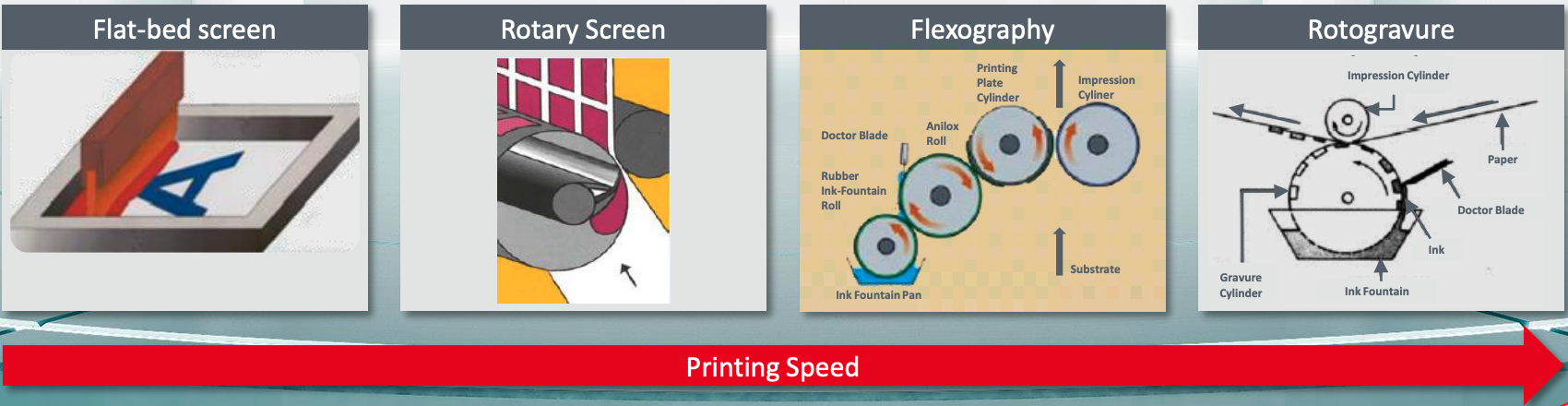
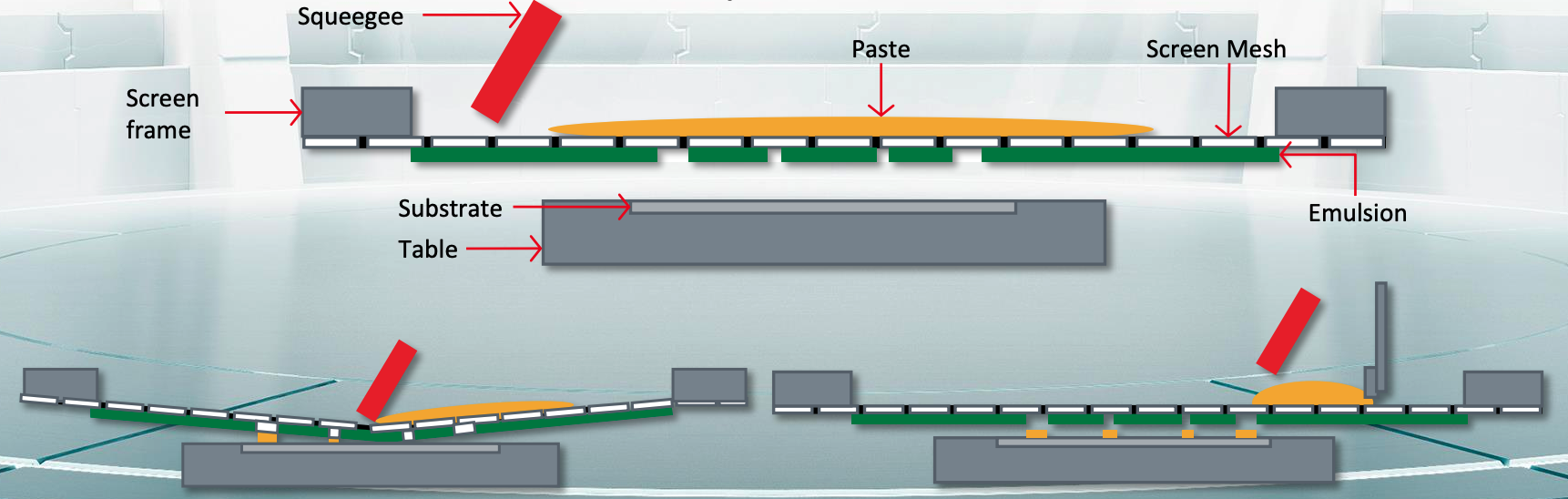
Screen printing is a printing technique that uses a woven mesh to support an inkblocking stencil. A squeegee is moved across the screen stencil forcing the ink past the threads of the woven mesh in the open areas. For screen printing you use this mesh acting like a driver between the paste and the substrate. After applying pressure with the squeegee the air pressure will press out the ink from the open area and onto the substrate to imprint the circuit.
Do not confuse Screen and Stencil printing. Stencil printing would be an option if you only wanted to print dots and small lines but not for a whole circuit. Typically metal stencils don\'t need a distance from the substrate and have a different operational "logic" even though they look and sound similar.
Dispenser printing
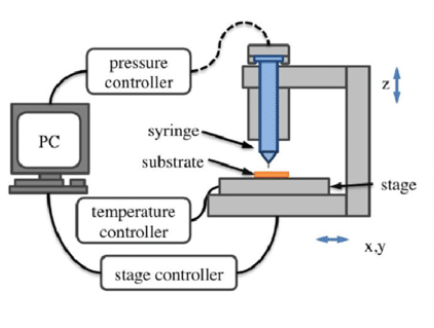
In dispenser printing, an ink nozzle continuously sprays ink slurries onto a substrate under pneumatic pressure. The substrate is moved by an x-y stage, typically under computer control, to create the desired design topology. Conformal writing with feature sizes as small as 250 nm can be accomplished by adjusting the ink rheology, stage movement speed, and distance between nozzle and substrate. Moreover, dispenser printing is capable of printing very thick films up to 200 µm.
Inkjet printing
Inkjet printing is a derivative of dispenser printing where ink drops exit the nozzle by a dynamic process. Inkjet printing is generally categorized into the continuous inkjet and the drop-on-demand (DoD) method. Due to its material relevance for thermoelectric device fabrication, we will primarily focus on DoD printing. By controlling the contraction expansion of the piezoelectric actuator, individual ink droplets can be jetted out from the nozzle forming the desired pattern on the substrate. The printed pattern can be easily modifed by changing the digital file that controls the actuator. The printability depends on the nozzle radius and viscosity, density and surface tension of the ink.

Aerosol jet and Spray Printing
Aerosol jet printing is another popular method for printable electronics. In this method, an atomizer aerosolizes the ink into liquid particles of size ranging from 20 nm to 5 mm. Inert gas or compressed airfow is used to transfer the ink particle to the substrate. The main advantage of spray printing is the higher allowable distance between print head and substrate making it possible to print on non-flat and non smooth substrates. The achievable resolution is higher than inkjet printing. However, edge sharpness in lower and localized crystallization caused by the sheath gas can detrimentally affect the bonding layer quality.
Drying and Curing
Proper drying and curing is very important to obtain the required coating performance. Drying refers to the solvent evaporation while curing refers to the active binders and resins that crosslink. While printing is a very important part of the process, drying is as important.
- Products are applied wet onto the substrate
- The drying/curing process removes the solvent from the coating and drives the crosslinking of the resin matrix (thermosetting systems)
- Coating shrinks and interparticle contacts generate the functionality (conductivity)
Solvent needs to be "removed" from the initial layer during the drying step, something that will cause a shrinkage of ~50-70% of the thickness and result in inter-particle contacts that will give the final functionality and conductivity of the coating.
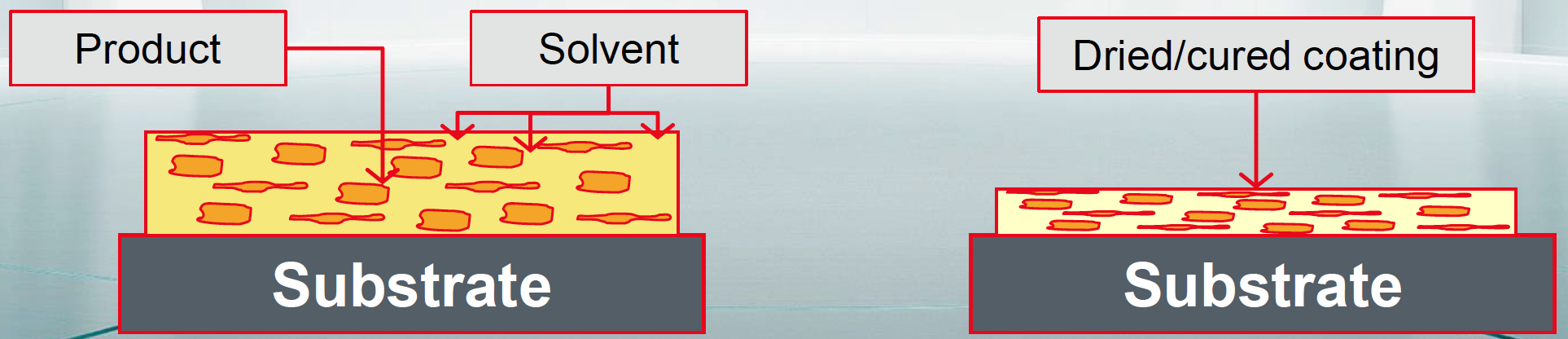
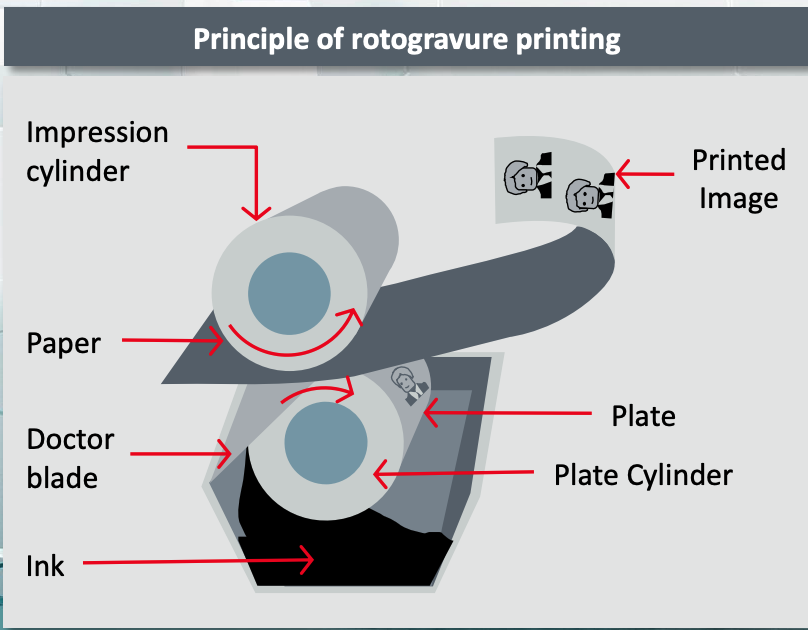
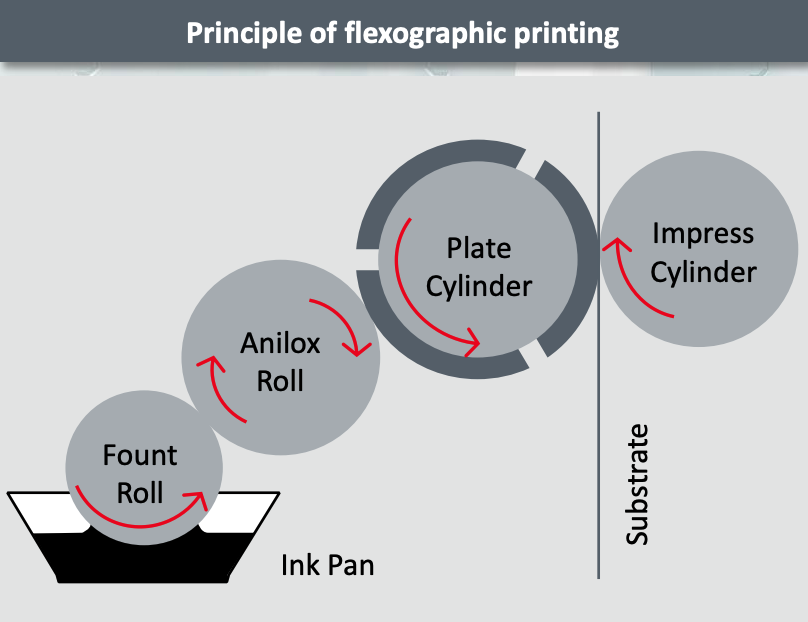
There are multiple solvents that can be used that depend on the processes and how fast or slow we want to the product to dry. For example for the fast drying solvents of flexo/gravure printable inks, solvents can be propyl acetates while for screen printing where we need a proper "open" screen time and slower drying, "solvents" used are carbitol acetate, butyl glycol acetate and such.
It is crucial to notice that "dry" to touch does not mean cured. You should make sure that you follow the instructions on the technical sheets in order to achieve the final properties and keep in mind that drying below 60°C (at least for screen printable inks) is not possible.
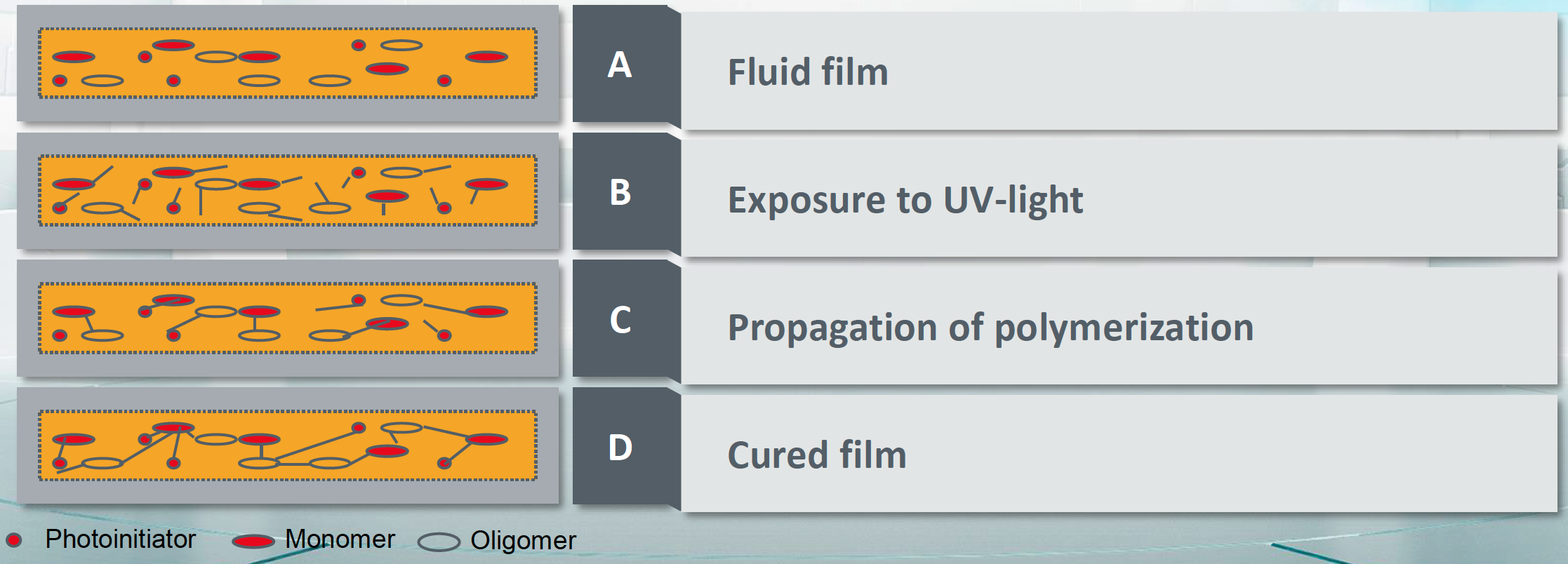
The drying mechanism is different when a product is UV curable since there\'s no solvent involved and the drying/curing process does not exist in the same sense. UV curable inks are a blend of monomers and oligomers that react together when exposed to UV light. In this case there\'s hardly any shrinkage or weight loss and exposure to UV light "just" propagates or polymerises the film, resulting in the final properties.