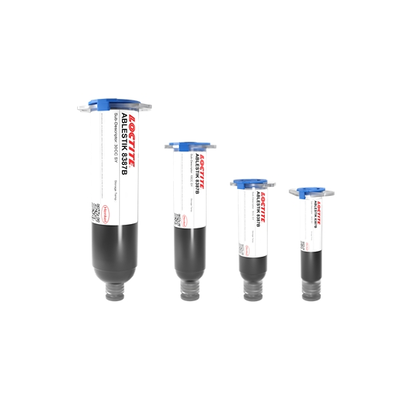
LOCTITE ABLESTIK 8387B
Harmonization Code : 3506.10.00.00 | Prepared glues and other prepared adhesives, not elsewhere specified or included; products suitable for use as glues or adhesives, put up for retail sale as glues or adhesives, not exceeding a net weight of 1 kg
Main features
- Fast cure
- Aerospace applications
- Glass attach for 3d sensors
Product Description
LOCTITE® ABLESTIK 8387B non conductive die attach adhesive has been formulated for use in high throughput die attach applications. It has an average filler size of less than 20um with a maximum of less than 30um and has been used for the glass attach of Optical and 3D sensors. It has been successfully used for lid attach in aerospace and defence applications and should pass the NASA outgassing standards if cured properly.
LOCTITE® ABLESTIK 8387B has good adhesion to glass, is jettable and has minimal adhesion change, post reliability. It can be fast cured using directed heat energy or hot plate curing techniques. In conventional box or convection conveyor oven curing, it will cure at temperatures as low as 100ºC.
Cure Schedule
- 2 minutes @ 150°C
- 30 minutes @ 100°C
8387B
Unlike other products we offer, the products listed on this page cannot currently be ordered directly from the website.
 Shipping in 20 days
 Shipping in 12 weeks
 Shipping in 45 days
Packaging
TDS, SDS & Technical Documents
- LOCTITE ABLESTIK 8387B
- LOCTITE ABLESTIK 8387B
- LOCTITE ABLESTIK 8387B known as Ablebond 8387B (14
Technical Specifications
General Properties
Thermal Properties
Physical Properties
Additional Information
Thawing Die attach with a cartridge heater
You should never heat up a cartridge from a frozen material, as this will highly impact work life and reduce it to a few hours, and in addition, particles will start to agglomerate. Especially with highly reactive and fast-curing products like 8387B, heating syringes will only make dispensing performance worse. You can use a needle heater to a maximum of 45°C instead, so the bulk syringe won’t be exposed to heat for a longer time.
Fix die attach clogging with Auger valves
Auger equipment with long (10mm) needles has the potential to lead to clogging issues. You might be tempted to think that the material is the one to blame, while in fact, it is likely that you should just keep your process simple. The filler % in 8387B is not so high, but the problem is the very small and very long needle in combination with the screw master. The Musashi auger pitch is too big for this needle type, which means that it forces too much material per cycle through the needle creating stress and clogging. We suggest using Musashi equipment with simple time/pressure (T/P), especially since their T/P controller is very accurate in material repeatability. This is the best system in the world, so we always suggest using a Time/Pressure system if possible.
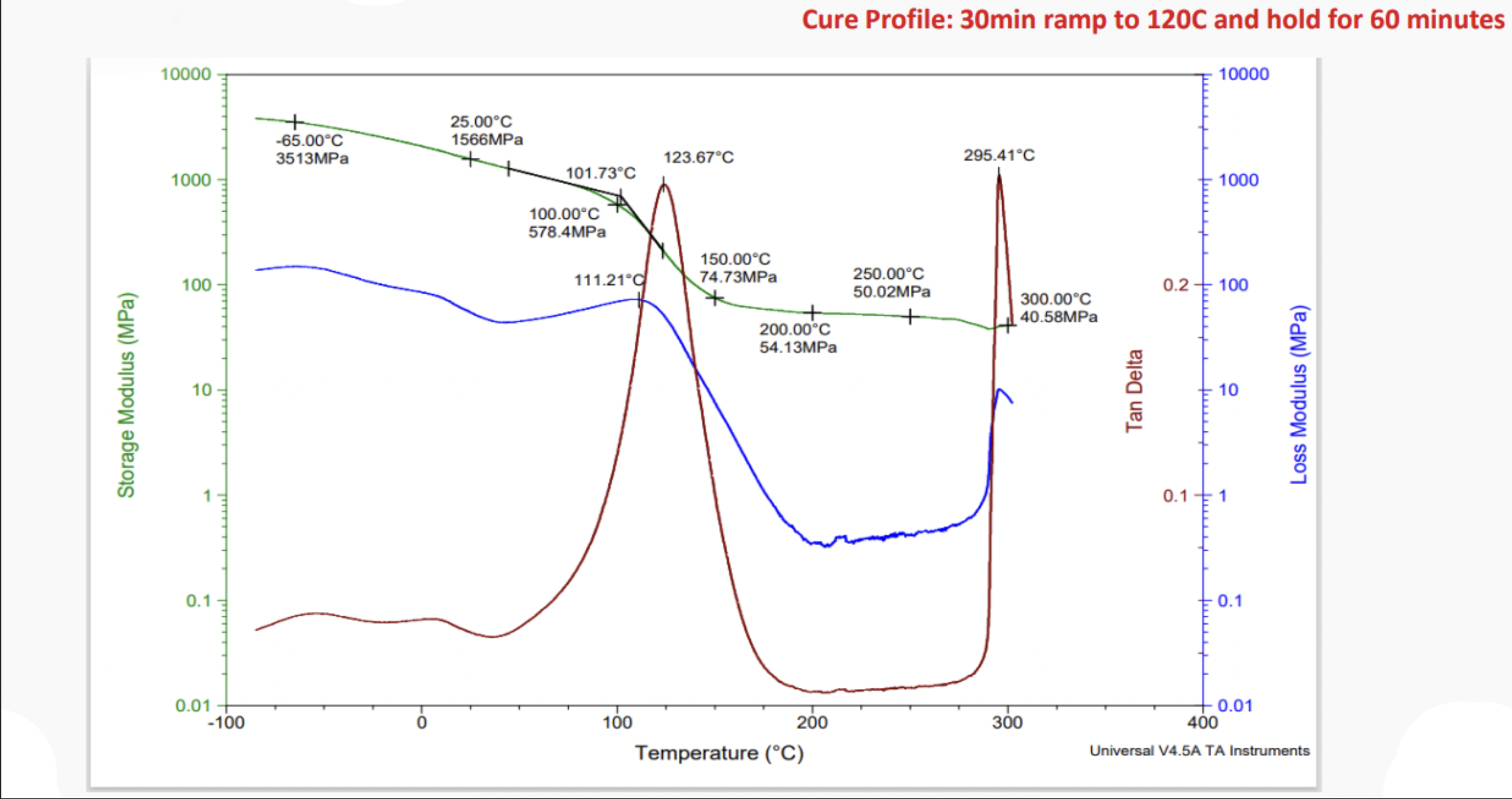
DMA Curve of 8387B
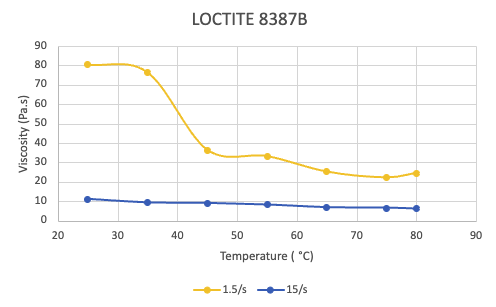
Viscosity vs Temperature curves
Method 1 : TpAg - 200µm - 20 mm plate
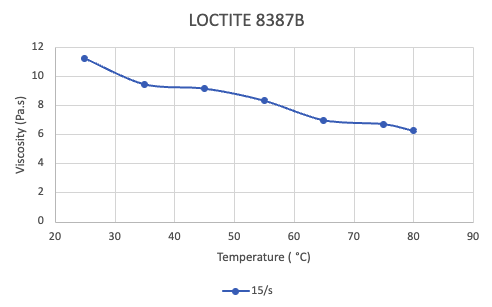
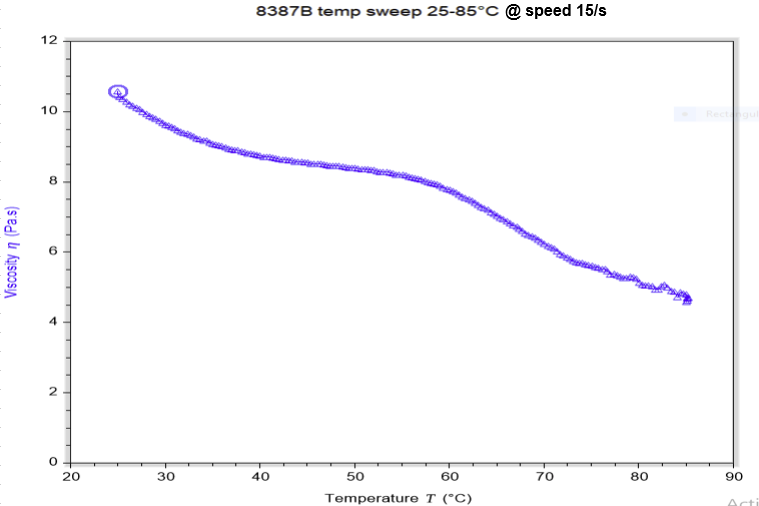
Method 2 : Temperature sweep - 200µm - 20 mm plate