
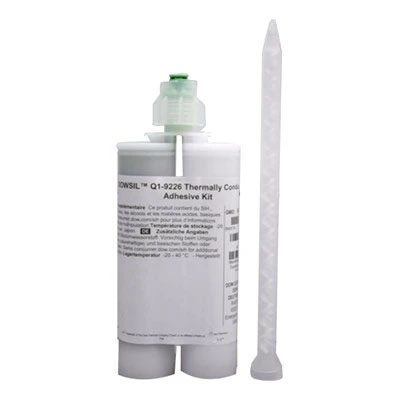
DOWSIL™ Q1-9226 Thermally Conductive Adhesive
Harmonization Code : 3910.00.00.90 | Silicones in Primary Forms; Others

Main features
- Two-part system
- Accelerated heat cure
- Robust mechanical & electrical profile
Product Description
DOWSIL™ Q1-9226 Thermally Conductive Adhesive is a two-part, semi-flowable thermally conductive silicone adhesive. It utilizes an accelerated heat cure system that produces no by-products, making it suitable for deep section and confined cures]. With a 1:1 mix ratio and a long pot life, it provides ease of use alongside reliable, self-priming adhesion to a variety of common substrates.
Product Key Features
- Two-Part System - offers an easy-to-use 1 to 1 mix ratio by weight or volume to simplify the preparation process.
- Accelerated Heat Cure - designed to be cured at 100°C (212°F) or above, with cure rates that rapidly accelerate under heat.
- Thermal Management - acts as a thermal bridge with a thermal conductivity of 0.8 W/mK to efficiently transfer heat away from devices to heat sinks.
- Robust Mechanical & Electrical Profile - cures to deliver a Shore A hardness of 67, a tensile strength of 4.15 MPa (600 psi), 124% elongation, and a dielectric strength of 25 kV/mm.
- Deep Section Cure Capability - addition-curing materials contain all ingredients needed for cure with no by-products, allowing for even curing in completely confined or deep sections.
Applications
This adhesive is designed for applications where thermal management and efficient heat transfer from a device to the ambient environment are primary concerns.
- Automotive Control Modules: Typically used for bonding organic and ceramic substrates to heat sinks in automotive applications.
- PCB System Assemblies: Ideal for the thermal management of printed circuit board system assemblies, helping to ensure cooler, more efficient operation and improved reliability.
- Broad Substrate Bonding: Develops good, primerless adhesion to a variety of common substrates including metals, ceramics, epoxy laminate boards, reactive materials, and filled plastics.
DS-Q19226
Unlike other products we offer, the products listed on this page cannot currently be ordered directly from the website.
 Shipping in 5 weeks
Packaging
TDS, SDS & Technical Documents
- 11-3059-01-dowsil-q1-9226-thermally-conductive-adhesive
Technical Specifications
General Properties
Physical Properties
Mechanical Properties
Electrical Properties
Thermal Properties
Additional Information
DOWSIL™ Q1-9226 Thermally Conductive Adhesive
DOWSIL™ Q1-9226 Thermally Conductive Adhesive is a two-part, semi-flowable silicone adhesive system formulated to act as an efficient thermal bridge for sensitive electronic assemblies. Delivering a balanced thermal conductivity of 0.8 W/mK, this addition-cure system cross-links under heat without generating volatile by-products, making it perfectly suited for deep sections or complete component confinement. It provides a long pot life for optimal manufacturing flexibility and establishes robust, self-priming structural adhesion to dissipate heat and maximize the reliability of compact device modules.
Typical engineering values only. Cure rates are accelerated by elevated temperatures; processing times depend on section thickness.
Key Features
- Two-part addition-cure silicone system generates no chemical by-products, ensuring void-free deep section cure.
- Optimized thermal conductivity (0.8 W/mK) forms a reliable path to drain operational heat away from substrates.
- Self-priming adhesion builds robust unprimed mechanical lock to metals, ceramics, laminates, and plastics.
- Long compound pot life minimizes inline production material waste and maximizes dispensing process windows.
- Maintains structural elastomer properties and dependable dielectric strength across a -45°C to 200°C footprint.
- Enables low thermal resistance and ultra-thin Bond Line Thicknesses (BLTs) to optimize thermal path management.
Processing Summary
Process Notes
- Retain inside original protective packaging with covers tightly attached to block contaminants.
- Thermally conductive fillers can exhibit gradual settling over several weeks of storage.
- Thoroughly mix each component separately prior to combining to ensure a uniform compound blend.
- Verify expiration dates tracked on the batch container label before assembly setup.
- Clean joint faces with Dow OS fluids, naphtha, mineral spirits, or methyl ethyl ketone (MEK).
- Do not use acetone or isopropyl alcohol (IPA) alone, as they do not remove heavy oils well.
- Incorporate fine surface mechanical abrasion to expand active bonding area.
- Apply specialized thin coatings of Dow primers to maximize activity on non-reactive plastic boundaries.
- Configured to process smoothly across manual tracks or automated meter/mix dispense stations.
- Automated airless dispense machinery can minimize or completely eliminate degassing cycles.
- If degassing is required, process mixed paste at >28 inches Hg for 10 minutes or until bubbling stops.
- Screen highly plasticized substrates; mobile plasticizers can act as release agents and impair hold.
Engineering Data for DOWSIL™ Q1-9226
Uncured Physical Properties (As Supplied)
| Physical Property | Part A Value | Part B Value | Mixed Value |
|---|---|---|---|
| Appearance / Color | Gray viscous compound | ||
| Viscosity (cP / mPa-sec) | 48,000 | 43,000 | 59,000 |
| Viscosity (Pa-sec) | 48 | 43 | 59 |
Cured Mechanical & Thermal Properties
| Cured Attribute | Typical Value | Unit / Standard Metric |
|---|---|---|
| Thermal Conductivity (hot disk) | 0.8 (0.46) | W/mK (btu/hr-ft-°F) |
| Specific Gravity (Cured) | 2.14 | - |
| Hardness | 67 | Shore A durometer |
| Tensile Strength | 600 (4.15 / 42) | psi (MPa / kg/cm²) |
| Elongation | 124 | % |
| Unprimed Adhesion (Lap Shear to Al) | 375 (2.6 / 260) | psi (MPa / N/cm²) |
| Dielectric Strength | 630 (25) | volts/mil (kV/mm) |
Where DOWSIL™ Q1-9226 Fits
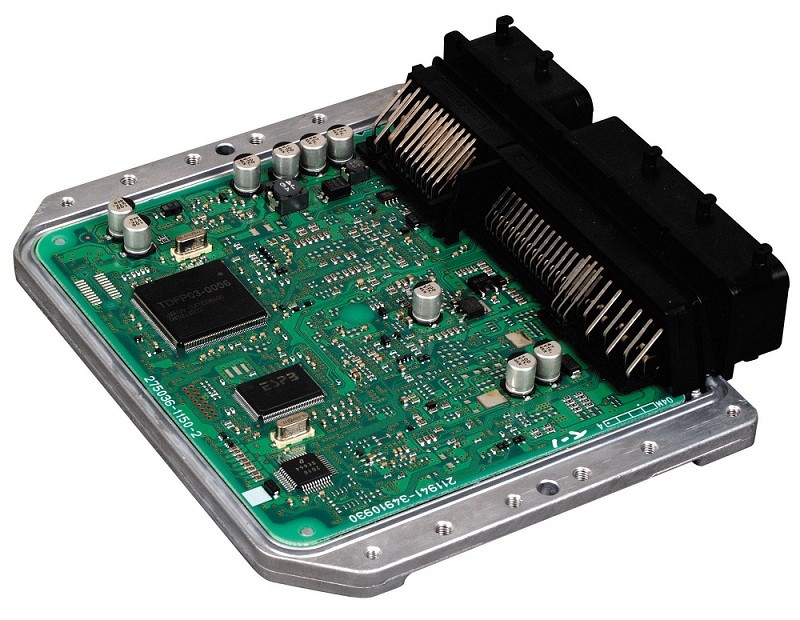
- Bonds organic and ceramic substrate designs.
- Fixes boards securely to dedicated metallic heat sinks.
- Addition-cure chemistry resists continuous operation stress.
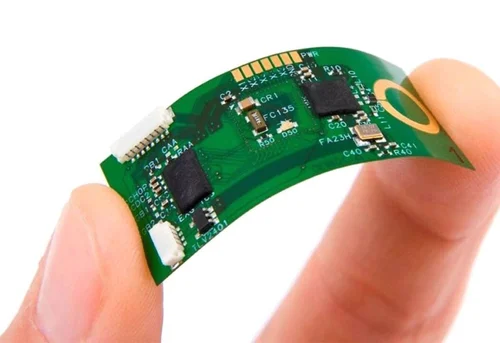
- Low thermal resistance protects sensitive IC blocks.
- Forms uniform heat transfer lines to optimize device safety.
- Allows for cooler operation and improved device reliability.
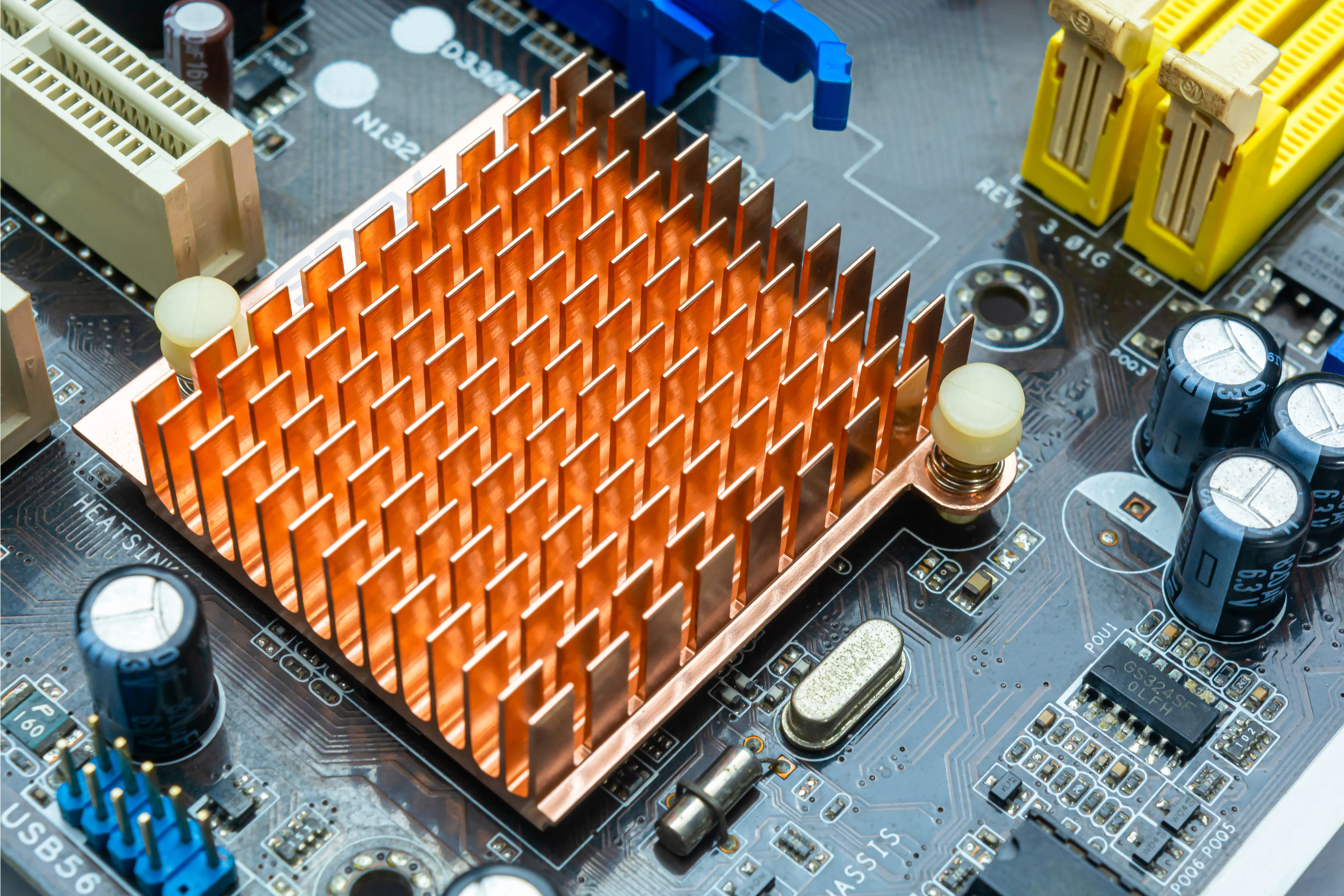
- Cure parameters advance uniformly throughout the volume.
- Generates absolutely no chemical cure by-products.
- Semi-flowable paste rheology supports flat or grooved application.
See Two-Part Thermally Conductive Silicone Dispensing Methods
Observe the high-precision processing of two-part thermally conductive silicone compounds via automated meter, mix, and dispense stations. This practical reference outlines ideal volumetric ratio tracking, static nozzle configuration, bubble elimination techniques, and clean thixotropic paste placement.
Standard Packaging & Technical Help
- Packaged as distinct matching Part A and Part B component kit configurations.
- Supplied ready-to-use in standard industrial protective vessel classes.
- Containers must be stored with covers tightly attached to avoid moisture or fluid contamination.
- Manage warehouse tracking using expiry limits listed clearly on the product batch labels.
- Fine-tuning baking oven schedules to achieve efficient cross-linking times on your line.
- Auditing component surfaces to rule out addition-cure catalyst inhibition parameters.
- Advising on vacuum de-airing metrics to minimize micro-voids in deep potting profiles.
- Coordinating lab-scale substrate evaluations to ensure 100% cohesive failure performance.
Tips and Troubleshooting
| Issue | Recommended Action |
|---|---|
| Light-colored streaks or distinct marbling visible across the mixed bead profile |
|
| Occurrence of micro-voids or bubble clusters within cured deep sections |
|
| Adhesion tracking breakdown or low lap shear metrics on difficult substrates |
|
Ready to Qualify DOWSIL™ Q1-9226?
Recently viewed products
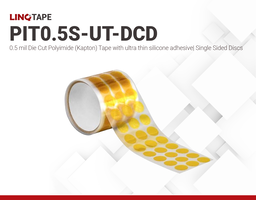
PIT0.5S-UT-DCD | 0.5 mil Die Cut Polyimide (Kapton) Tape with silicone adhesive| Single Sided Discs
- 0.5 mil polyimide film
- Ultra Thin Silicone Adhesive
- Die cut discs

BMI-3000 CG Low Cost Bismaleimide (Imide Extended) in Powder Form
- Superior thermal stability
- High adhesion to various substrates
- Hydrophobic toughener


