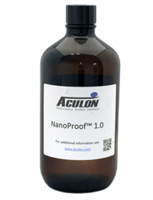
NanoProof 2.1 PCB Waterproofing Surface Treatment
Harmonization Code : 2901.10.00.00 | Acyclic hydrocarbons; Saturated

Main features
- Hydrophobic treatment
- 30-50 μm thickness
- IPX7, IPX8
Product Description
NanoProof 2.1 is a surface treatment designed to impart hydrophobicity and reduced friction to circuit boards and electronic components. It is a simple, one-step process that provides a basic protective film for liquids.
NanoProof 2.1 is a PFAS free, easy to use, and the dried film is nonconductive. The treatment can adhere to a broad range of substrates and contains a UV tracer. This product also requires no cure and can be applied through various methods including dispense and dip.
Advantages of Aculon's NanoProof 2.1
- More forgiving during application
- 30-50 μm thickness
- No cure required
- Deformable (gel like) coating so needs to be handled with care
- Contains UV tracer
- RoHS and REACH compliant
- PFAS Free
Utilization of multiple options
Please note that many customers have found significant success utilizing two or more of the available NanoProof® technologies successfully. Often times the most sensitive components benefit from the most robust NanoProof® technology (5.1) while the remaining components can be coated with the less robust coatings to benefit from their electrical push-through capability, flexible nature, and lower costs!
Detection/Inspection
All NanoProof products contain a UV Tracer which is visible under 365nm wavelength UV light (Detectable by both the human eye and automated detection systems). Please note that soldermasks and other substrate materials containing a UV tracer may make accurate detection of NanoProof difficult.
Packaging
TDS, SDS & Technical Documents
- NanoProof 2.1 TDS
- Aculon NanoProof 2.1 SDS
Technical Specifications
General Properties
Thermal Properties
Electrical Properties
Physical Properties
Additional Information
How to apply NanoProof 2.1
|
STEP 1 ⇨ CLEAN |
STEP 2 ⇨ TREAT |
STEP 3 ⇨ DRY |
| Parts must be sufficiently clean before treatment for proper bonding and effective application. This can be accomplished by first degreasing the surface with solvents/rinsing with IPA. |
Dip - Fully immerse the part in the treatment solution and withdraw at 1-5 mm/second (faster withdraw rate increases coating thickness). |
To dry, the part should be placed at room temperature until the solvent is evaporated. Depending on thickness, parts should be fully cured in 60 minutes.
|
|
Dispense - Dispense the treatment over the surface, applying enough to coat the entire surface. Allow excess material to drain. |
Application Tips
- In some cases, Kyzen cleaners like Ionox I3s416 or Cybersolv 141-R may be appropriate for removing surface contamination.
- For dip applications, dip containers should be stainless steel, glass, or aluminum. Plastic containers are likely to contaminate the solution.
- Use a microfiber cloth to wipe after cleaning.
- Coat the substrate as soon as possible after cleaning to prevent recontamination.
- Cure temperatures and conditions should be optimized based on substrate and durability requirements.
- Expect no mask to be compatible
- Methylcyclohexane can be used as a diluent
| Recommendation for tubing and plastics via application equipment | ||
| Compatible with: | SS Nozzles/Dispensers, Polyethylene terephthalate (PET), Polytetrafluoroethylene (PTFE), | |
| Incompatible with: | HDPE, LDPE, Polyurethane, PVC, Tygon, Noryl, ABS, PP, Polyphenol ethylene ether, silicone, neoprene, EPM, and natural rubber |
|