
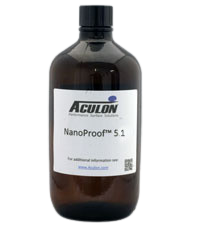
NanoProof 5.1 PCB Waterproofing Surface Treatment
Harmonization Code : 2901.10.00.00 | Acyclic hydrocarbons; Saturated
Main features
- Hydrophobic/Oleophobic treatment
- 6-9 µm thickness
- IPX5
Product Description
NanoProof 5.1 is a nanoscale surface treatment designed to impart hydrophobicity and oleophobicity to a wide variety of surfaces including most metals, semiconductors, and polymers. It is a simple, one-step process that creates moisture barriers on coated parts to repel water, oil, and other liquid organic materials. With a coating thickness of 6-9µm and an IPX5 Rating, it is ideal for PCB waterproofing and imparting repellency to consumer electronics.
Advantages of Aculon's NanoProof 5.1
- Can be applied through dip, spray, or dispense
- IPX5
- No cure required
- Handleable when dry
- Contains UV tracer
- RoHS and REACH compliant
- Contains PFAs
Utilization of multiple options
Please note that many customers have found significant success utilizing two or more of the available NanoProof® technologies successfully. Often times the most sensitive components benefit from the most robust NanoProof® technology (5.1) while the remaining components can be coated with the less robust coatings to benefit from their electrical push-through capability, flexible nature, and lower costs!
Detection/Inspection
All NanoProof products contain a UV Tracer which is visible under 365nm wavelength UV light (Detectable by both the human eye and automated detection systems). Please note that soldermasks and other substrate materials containing a UV tracer may make accurate detection of NanoProof difficult.
Packaging
TDS, SDS & Technical Documents
- Aculon NanoProof 5.1 SDS
Technical Specifications
General Properties
Thermal Properties
Electrical Properties
Other Properties
Physical Properties
Additional Information
How to apply NanoProof 5.1
|
STEP 1 ⇨ CLEAN |
STEP 2 ⇨ TREAT |
STEP 3 ⇨ DRY |
| Parts must be sufficiently clean before treatment for proper bonding and effective application. This can be accomplished by first degreasing the surface with solvents/rinsing with IPA. |
Dip - Fully immerse the part in the treatment solution for 20 seconds. Withdraw the part at a steady rate to ensure even coverage. |
To dry, the part should be placed at room temperature for 2 hours. For faster curing, additional thermal treatment at 60°C will speed solvent evaporation.
|
|
Spray - Spray the solution on the substrate, air dry. If the coating is too thick, reduce the amount applied by changing the settings on the spray gun or using a diluent. |
||
|
Dispense - Dispense the treatment over the surface, applying enough to coat the entire surface. Allow excess material to drain. |
Application Tips
- Use a microfiber cloth to wipe after cleaning.
- Coat the substrate as soon as possible after cleaning to prevent recontamination.
- Spray Equipment Suggestion
- Spray & Dispense Valve - The PVA FCS300 Valve has been tested and confirmed compatible with all NanoProof products.
- Manual Coating System - The PVA MCCS-SYS-1 Manual Conformal Coating System has been tested and confirmed compatible with all NanoProof products.
- Automated & Selective Coating - The PVA Delta 8 Selective Coating / Dispensing System has been tested and confirmed compatible with all NanoProof Products.
- Cure temperatures and conditions should be optimized based on substrate and durability requirements.
How to test for Hydrophobicity
To test for hydrophobicity, allow water droplets to fall onto the surface, which should bead up to a contact angle >90⁰. If the contact angle is <90⁰, then the surface is not
hydrophobic. The surface should be cleaned again and the treatment reapplied.


