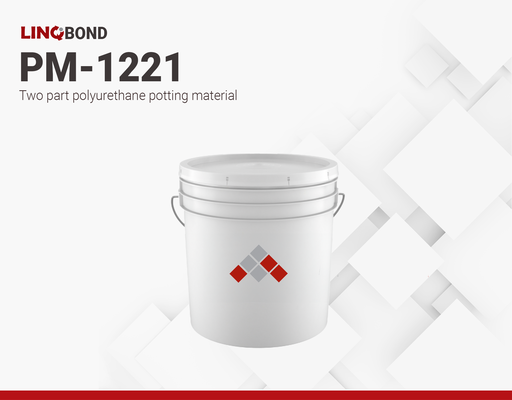
LINQBOND PM-1221 | Two part polyurethane potting material
Harmonization Code : 3909.20.00.90 | Amino-resins, phenolic resins and polyurethanes, in primary forms : Melamine resins : Other
Main features
- Low-stress potting material
- Excellent seismic and voltage resistance
- Room temperature curing
Product Description
LINQBOND PM-1221 is a two-component polyurethane potting material engineered for low-stress applications. It offers good insulating properties and exceptional high-temperature, shock, and voltage resistance. With its excellent fluidity during application and minimal bubble formation upon curing, LINQBOND PM-1221 seamlessly integrates into your projects, ensuring a smooth and reliable finish.
LINQBOND PM-1221 is the ideal choice for casting bonding, and sealing electronic components operating in challenging environments such as high pressure, high frequency, humidity, and heat. It is perfectly suited for precision arresters, various transformers, filters, control boards, and igniters. LINQBOND PM-1221 viscosity can be customized according to customer requirements. Other available colors can be found in the selector guide below.
Available Versions
-
LINQBOND PM-1221: Precision Bonding with Low-Stress Protection (STD)
-
LINQBOND PM-1221 Type E: High-Hardness Epoxy Replacement
-
LINQBOND PM-1221 Type M: Multi-Function Environmental Sealant
-
LINQBOND PM-1221 Type S: Flexible, Repairable Silicone Alternative
-
LINQBOND PM-1221 Type F Adhesive: Precision Bonding for Electronic Components
PM-1221
Unlike other products we offer, the products listed on this page cannot currently be ordered directly from the website.
 Shipping in 12 weeks
 Shipping in 12 weeks
 Shipping in 12 weeks
Packaging
TDS, SDS & Technical Documents
- MSDS_LINQBOND PM-1221.docx
- TDS _LINQBOND PM-1221
Technical Specifications
General Properties
Thermal Properties
Electrical Properties
Chemical Properties
Additional Information
LINQBOND PM-1221 Polyurethane Potting and Adhesive Solutions
Unmatched Protection, Durability, and Performance for Precision Electronics
Discover the PM 1221 series—a high-performance line of polyurethane potting and adhesive solutions tailored to meet the unique demands of sensitive electronic components, from precision capacitors to transformers, control boards, and more. Designed to outperform standard materials, each formulation in the PM 1221 range delivers specific features that address key performance needs, offering robust protection with specialized functionality.
LINQBOND PM-1221 Polyurethane Potting Sealant: Precision Bonding with Low-Stress Protection
This all-in-one potting sealant excels in low-stress, seismic-resistant applications, ensuring long-lasting integrity under electrical, mechanical, and environmental pressures. Specifically designed for arresters, transformers, filters, and control boards, it boasts excellent electrical insulation and resistance to vibration, delivering an ideal solution for components in high-performance environments.
Key Benefits
- Low-Stress, Seismic-Resistant: Reduces risk of component fatigue
- Superior Electrical Properties: Optimal for voltage-intensive applications
- Versatile Compatibility: Bonds with a wide range of electronic components
LINQBOND PM-1221 Type E: High-Hardness Epoxy Replacement
Engineered with high hardness and durability, PM 1221 Type E is the go-to choice for applications requiring a firm, resilient bond. Ideal for potting precision capacitors, this sealant provides a stable alternative to traditional epoxy with greater ease of handling. When used with vacuum deaeration and heating equipment, it cures to a dense, rigid form with minimal bubbles—perfect for reinforcing and safeguarding intricate components.
Key Benefits
- High Hardness: Perfect for high-stress environments
- Epoxy Alternative: A cleaner, versatile substitute
- Precision Protection: Formulated for high-performance capacitors
LINQBOND PM-1221 Type M: Multi-Function Environmental Sealant
Purpose-built for environmental durability, PM 1221 Type M ensures electronics remain insulated, waterproof, and shockproof, even in challenging conditions. It’s the ultimate choice for protecting devices from moisture, dust, and other environmental hazards, providing complete peace of mind in a single potting and sealing solution.
Key Benefits
- Comprehensive Protection: Moisture-proof, shockproof, and waterproof
- Environmental Resilience: Seals against air, moisture, and external elements
- Broad Application: Suitable for diverse electronic assemblies
LINQBOND PM-1221 Type S: Flexible, Repairable Silicone Alternative
With unmatched elasticity and toughness, PM 1221 Type S offers a repairable, highly flexible sealant ideal for applications requiring both durability and the option to make modifications. This type outperforms traditional silicone potting in electrical properties, offering enhanced flexibility without compromising performance.
Key Benefits
- Repairable Flexibility: Adaptable for evolving project needs
- High Elasticity and Toughness: Ensures long-term durability
- Silicone Replacement: Enhanced electrical performance with flexible rework options
LINQBOND PM-1221 Type F Adhesive: Precision Bonding for Electronic Components
Semi-flowing for easy application, PM 1221 Type F adhesive offers robust bonding and sealing for electronic components where precision matters most. It delivers a strong, lasting hold that withstands the demands of high-performance applications.
Key Benefits
- Semi-Flowing Application: Easy handling for precision bonding
- Reliable Adhesion: Ideal for secure bonding in sensitive electronics
- Optimized for Electronics: Designed specifically for electronic components
Experience the next level of electronic protection and performance with PM 1221’s tailored polyurethane solutions.
| Properties | PM-1221 | PM-1221 Type E | PM-1221 Type M | PM-1221 Type S | PM-1221 Type F |
|---|---|---|---|---|---|
| Part A Appearance | Transparent, White Gray, Black Liquid | ||||
| Part B Appearance | Light Yellow Liquid | ||||
| Part A Viscosity | 6,000-9,000 | 20,000 | |||
| Part B Viscosity | 300-400 | 400 | |||
| Mixed Viscosity | 3,000- 5,000 | 10,000-15,000 | |||
| Pot Life | 30-45 | ≤30 | 45-60 | 45-60 | ≤30 |
| Initial Curing Time | 5-7 | 3-5 | 8-10 | 8-10 | 3-5 |
| Full Cure Time | 36 | 24 | 48 | 48 | 24 |
| Shore Hardness | 70-90 Shore A | ≥80 Shore D | 50-70 Shore A | 30-50 Shore A | ≥80 Shore D |
| Shear Strenght | ≥2.3 | ≥3.5 | ≥1.5 | ≥0.8 | ≥4.8 |
| Specific Gravity | 1.5 -1.7 | ||||
| Linear Shrinkage Rate | 0.3 | ||||
| Working Temperature Range | -60 up to 150 | ||||
| Dielectric Strenght | ≥25 | ||||
| Volume Resistance | 1.0E15 | ||||
| Thermal Conductivity | ≥0.6 | ||||
Processing Instructions
- Mix component A and B according to specified ratio. Stir thoroughly to ensure uniformity while preventing air to be introduced into the mixture.
- Degas the mixture to remove the bubbles for about 5 minutes. Do not fill the container more than half full to prevent overflowing during degassing.
- Gradually pour the mixed compound into the device being potted. If the ambient temperature is around 5 °C, preheat components A and B to around 15 °C.
- Allow the potted workpiece cure at room temperature until the surface is dry. Full curing typically occurs within 24 hours. The curing process is influenced by temperature variations; generally, higher temperatures result in faster curing, while lower temperatures lead to slower curing.
Precautions for Use
- Use the mixture promptly after combining components A and B to prevent a significant increase in viscosity.
- If the components have been stored for an extended period and exhibit precipitation or stratification, they should be thoroughly mixed before use. Component B is prone to crystallization at low temperatures; therefore, it should be stored in a warmer environment to melt prior to use, ensuring product performance remains unaffected.
Please note that the provided information is based on available data and typical conditions. For specific applications and detailed test results, refer to the actual test data and conduct appropriate certifications.
Storage and Handling
Store in a ventilated, dry, and clean environment below 25 °C and 50% RH. Keep away from fire and heat sources. It is strictly forbidden to store in outdoor environments. At proper storage conditions, Part A and Part B has a shelf life of 6 months. Shelf life can be extended by using cold storage.