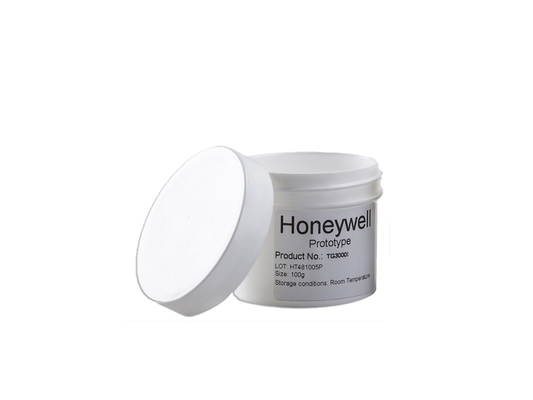
TG 3000I | Thermal Grease
Harmonization Code : 3824.99.96.99 | Prepared binders for foundry moulds or cores; chemical products and preparations of the chemical or allied industries (including those consisting of mixtures of natural products), not elsewhere specified or included : Other : Other: Other
Main features
- 0.003 Thermal Impedance
- 3.0 Thermal Conductivity
- 7μm BLT
Product Description
TG3000I Thermal Silicone Grease is the best thermal grease of our entire product line. It offers excellent thermal properties (3.0 TC and 0.003 TI) while also exhibiting excellent electrical properties. TG3000I has a maximum particle size of 7um and can reach a bond line thickness of 7 micron @35psi, 50oC. Its low viscosity and excellent thixotropy make it fit for large–scale production with dispensing, screen printing and stencil printing. Even though TC is seemingly average, the combination of Thermal impedance and minuscule bond line thickness along with its great electrical properties, make it the most advanced thermal grease in the market.
TG3000I is used for applications with highly advanced power density requirements. It is designed to minimize thermal resistance at interfaces, and maintain excellent performance through reliability testing. It provides superior thermal performance with ease of use across a multitude of applications. Its operating temperature range is -40oC to 150oC like the entire Thermal grease product range.
Key Features
- High-performance thermal grease for advanced power-density designs
- Thermal conductivity of 3.0 W/m·K with ultra-low thermal impedance of 0.003 °C·in²/W
- Thin bondline (~7 µm @ 35 psi, 50 °C) enabled by < 7 µm particle size
- Excellent electrical insulation (2.0 × 10¹² Ω·cm)
- Low viscosity and thixotropic for smooth dispensing, screen printing, or stencil printing
- UL 94 V-0 flammability rating for safety in critical assemblies
- Stable –40 °C to 150 °C operating range
- Cost-effective and reliable under thermal cycling and long-term stress
Typical Applications
- Flip-chip BGAs and CPUs
- Power devices and IGBT modules
- LED assemblies and drivers
- GPUs and high-power ASICs
- Automotive power units and ECUs
- Telecommunication and data center electronics
TG3000I
Unlike other products we offer, the products listed on this page cannot currently be ordered directly from the website.
 Shipping in 8 weeks
Packaging
TDS, SDS & Technical Documents
- Honeywell TG3000I SDS
- TG2000I-TG5500TDS0914
Technical Specifications
General Properties
Thermal Properties
Electrical Properties
Physical Properties
Additional Information
| Property | Nominal Value | Permissible Range / Tolerance | Test Method / Notes |
|---|---|---|---|
| Thermal Conductivity | 2.9 W/m·K | 2.7 – 3.3 W/m·K | Hot Disk Method |
| Thermal Impedance | 0.003 °C·in²/W | — | — |
| Viscosity | 339,600 cps @ 25 °C | 150,000 – 350,000 cps | Brookfield Viscometer |
| Specific Gravity | 3.4 | ± 0.1 | ASTM D792 |
| Volume Resistivity | 2.0 × 10¹² Ω·cm | ± 10 % | ASTM D257 |
| Flammability | V-0 | — | UL 94 |
| Operating Temperature Range | –40 °C to 150 °C | — | — |
| Shelf Life | 12 months (min.) | — | Room Temperature Storage |
| Bond Line Thickness | 7 µm @ 35 psi, 50 °C | ± 1 µm | Internal Method |
| Maximum Particle Size | 7 µm | — | Internal QC Standard |
| Format | Grease | — | — |
| Color | White | — | Visual Inspection |
Will I have any issues with fretting(friction) with Greases?
After conducting a thermally degrading test you might realise that these greases are highly filled(~93.5% residual mass). Can this be a cause for concern when it comes to fretting and friction? The short answer is no.
The long answer is that Zinc oxide and aluminum oxide are common fillers in greases and other TIMs. These materials are also used in our phase change TIMs and there has rarely been any issues with fretting (friction) during dispensing or other applications. Fretting is only a concern with boron nitride as filler. Friction related impact is also minimal on low viscosity greases. So you are safe.