
LOCTITE ABLESTIK 2030SC
Harmonization Code : 3506.91.90.99 | Prepared glues and other prepared adhesives, not elsewhere specified or included; products suitable for use as glues or adhesives, put up for retail sale as glues or adhesives, not exceeding a net weight of 1 kg ; Adhesives based on polymers of headings 3901 to 3913 or on rubber; Other ; Other
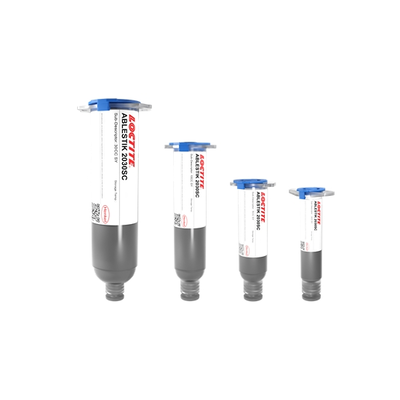
Main features
- Low warpage
- Snap cure
- Low stress
Product Description
LOCTITE ABLEBOND 2030SC die attach adhesive has been formulated for use in high throughput die attach applications. This material is designed to minimise stress and resulting warpage between dissimilar surfaces. It can be used in a variety of package sizes and can be used for most metalic key substrates.
LOCTITE ABLEBOND 2030SC is a Snap curable adhesive with a proprietary hybrid chemistry that has various cure schedules and can cure very fast. One recommended cure schedule is 10 sec @ 150°C.
Cure Schedule
- 90 seconds @ 110°C
- 10 seconds @ 150°C
2030SC
Unlike other products we offer, the products listed on this page cannot currently be ordered directly from the website.
 Shipping in 12 weeks
 Shipping in 12 weeks
 Shipping in 35 days
Packaging
TDS, SDS & Technical Documents
- LOCTITE ABLESTIK 2030SC
- LOCTITE ABLESTIK 2030SC known as Ablebond 2030SC (38g) NL-MSDS_UT_NL
- LOCTITE ABLESTIK 2030SC known as Ablebond 2030SC (38g) EN-MSDS_UT_EN
Technical Specifications
General Properties
Thermal Properties
Physical Properties
Additional Information
The TDS says to not re-freeze the material once its thawed out, and then its only lasts 24 hrs. Is there any way to extend this?
We do not recommend re-freezing. Partly because freezing down to -40°C takes a long time, and uses up a significant portion of the 24 hour worklife. And partly because condensation risks contaminating the sample with water. And partly because customers tend to lose track of the number of thaw/freeze cycles.
We generally suggest requesting the smallest syringe size/fill that is readily available and fits your process requirements.
However, if you restrict the refreeze to one time only (mark the syringe with a clear indicator), refreeze in a plastic zipper bag (to prevent later condensation), and freeze as rapidly as possible, it should be OK for initial evaluation. Do not exceed the 24 hours cumulative time at room temperature.
How should we handle the material at the tip of the syringe?
It is normal practice to “purge” the tip of the syringe before use. The sequence should be…
Try to keep the syringe vertical (tip down) throughout this process.
- Thaw the syringe to room temperature (about 15 – 30 min, depending on syringe size)
- Wipe away any condensation that has formed during the thawing.
- Remove to top cap – this will remove any pressure from inside the syringe
- Remove the tip cap
- Replace the tip cap with a dispense needle
- Fit the “receiver head” to the top of the syringe to supply pressure for dispensing
- Dispense (purge) a stream of glue from the dispense needle, until you get a continuous un-broken column. This indicates that the air has been removed from the tip, and you are “good to go”.
- If you leave the syringe idle for more than a few mins, clean off any glue that has appeared on the dispense needle with a clean-room wipe, and repeat the purge.
If you are going to re-freeze the syringe, remove the dispense needle, and replace the tip cap.
Recently viewed products
LOCTITE ABLESTIK 8200T
- High electrical conductivity
- Snap curable
- Excellent adhesion to Ag plated LF
LOCTITE ABLESTIK QMI536
- Bismaleimide resin
- One component
- Excellent dielectric properties
LOCTITE ABLESTIK QMI550
- Non conductive
- Hydrophobic
- Skip Cure
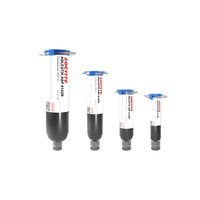
LOCTITE ABLESTIK ABP 8142B
- Low and stable modulus
- Snap cure or oven cure
- MEMs package applications


