
LOCTITE ECCOBOND FP4470
Harmonization Code : 3907.30.00.85 | Polyacetals, other polyethers and epoxide resins, in primary forms; polycarbonates, alkyd resins, polyallyl esters and other polyesters, in primary forms : Epoxide resins : Other

Main features
- High purity
- Green product
- Handles solder reflow temperatures
Product Description
LOCTITE ECCOBOND FP4470 is a silica/anhydride material (known in the US as CB0260) that features excellent flow properties allowing the material to penetrate fine pitch wires and deep cavities without entrapping voids. This proven epoxy encapsulant is used in high-reliability aerospace applications.
LOCTITE ECCOBOND FP4470 can withstand solder reflow after being exposed to JEDEC Level 2A (60°C/60% RH, 120 hours) preconditioning. It is a high adhesion version of FP4450 that handles higher solder reflow temperatures when necessary. In most cases it can be applied in the same way as 4450 with the same results and actually with lower moisture absorption.
Cure Schedule
- 30 minutes @ 125°C + 90 minutes @ 165°C
LOCTITE ECCOBOND FP4470 should be dispensed onto a substrate warmed to approximately 75°C.
FP4470
Unlike other products we offer, the products listed on this page cannot currently be ordered directly from the website.
 Shipping in 50 days
 Shipping in 12 weeks
 Shipping in 50 days
Packaging
TDS, SDS & Technical Documents
- LOCTITE ECCOBOND FP4470
- CoA FP 4470 09-20
- FP4470 viscosity stability @25°C & 50°C
- LOCTITE ECCOBOND FP4470 known as 6OZ IC ENCP FOR 260C RFLW -40CD NL-MSDS_UT_NL
- LOCTITE ECCOBOND FP4470 known as 6OZ IC ENCP FOR 260C RFLW -40CD NL-MSDS_EN
Technical Specifications
General Properties
Thermal Properties
Other Properties
Chemical Properties
Physical Properties
Additional Information
How does this product fare compared to the rest of the close FP family?
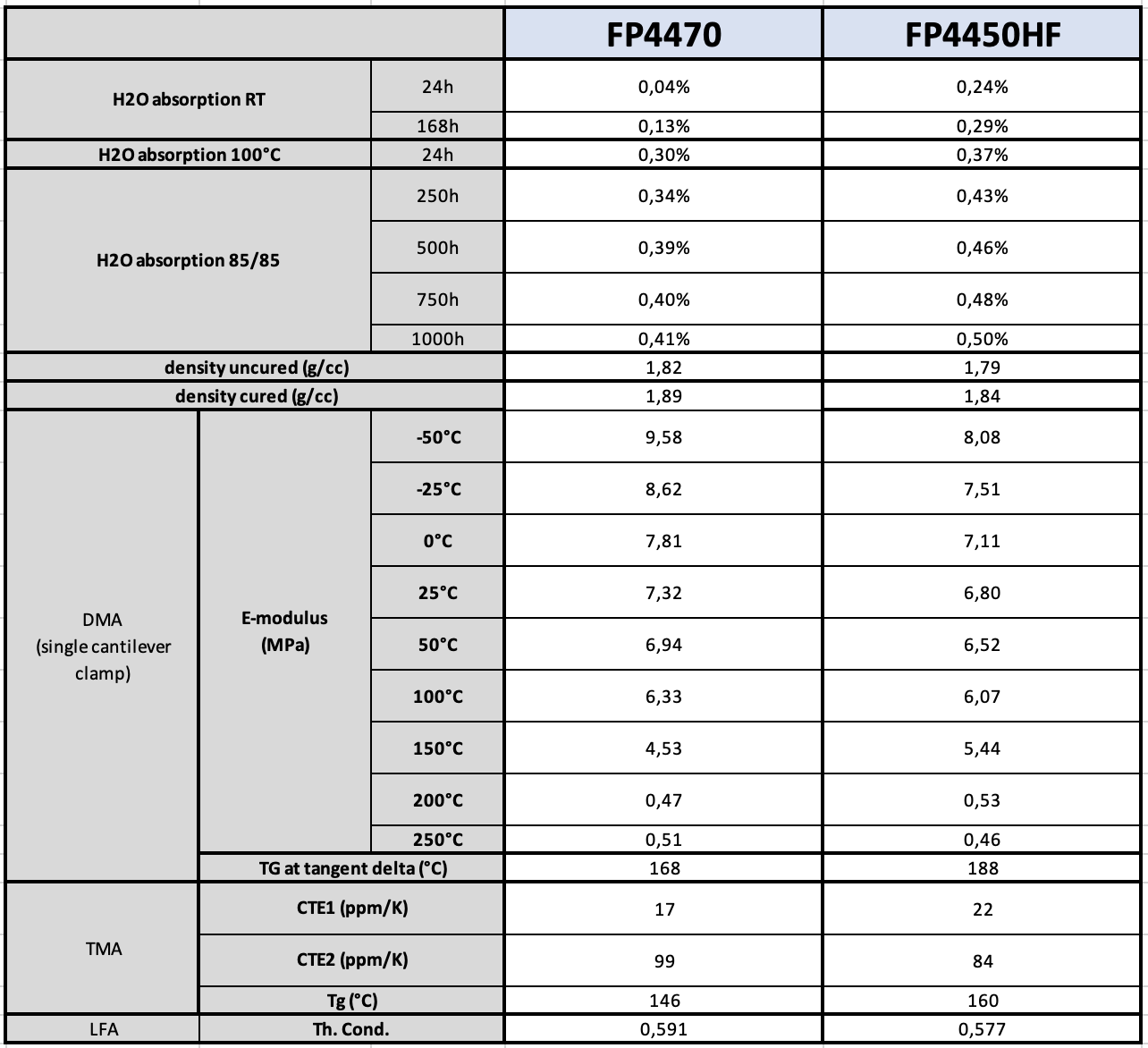
FP 4470 uses the same hardener system as 4450, but the epoxy/anhydride resin system is slightly more different compared to FP 4450(HF). Tg is lower and 4470 has few % higher filler loading for lower CTE (19 vs 17ppm). FP 4470 also has smaller filler particle size (<50um) vs FP 4450 and higher adhesion vs FP 4450(HF).
We have internal information showing that these legacy semiconductor liquids pass UL94HB at 1/8” thickness but do not have the test data or yellow card nor are we going to test for it. This is anecdotal but, hopefully, helpful.
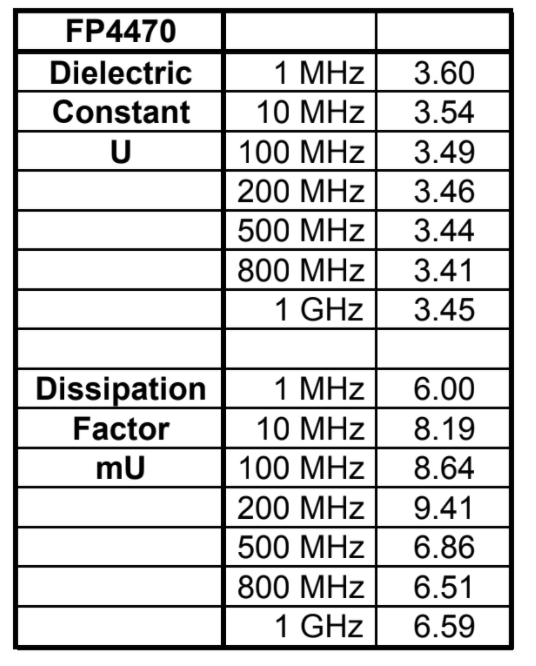
The following are some older tested values for your assistance and information but, by no means, guaranteed specifications.
Thermal Analysis Data
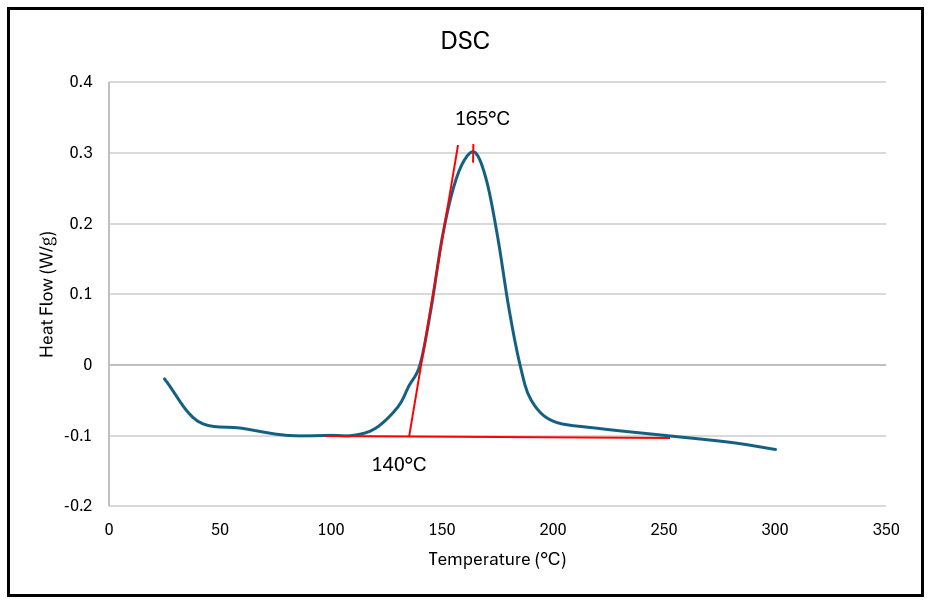
The on-set temperature of FP4470 is around 140 Celsius as calculated by the X-section of the 2 red lines. You can imagine that the positioning of the red lines is a bit “subjective”, so different people & different software can get slightly different results from the same curve. Nevertheless, this is widely accepted as the “standard” method of calculating the on-set temperature.
A more interesting point is that the calculated on-set is always higher than the START of CURE. This is where the material starts to exotherm, and the baseline deviates upwards from a straight line. In this case it is 100°C, so curing at 140°C or 150°C should be OK (similar to FP 4450 for which we recommend 165°C cure, but companies have been using 140°C for decades due to their "sensitive components".
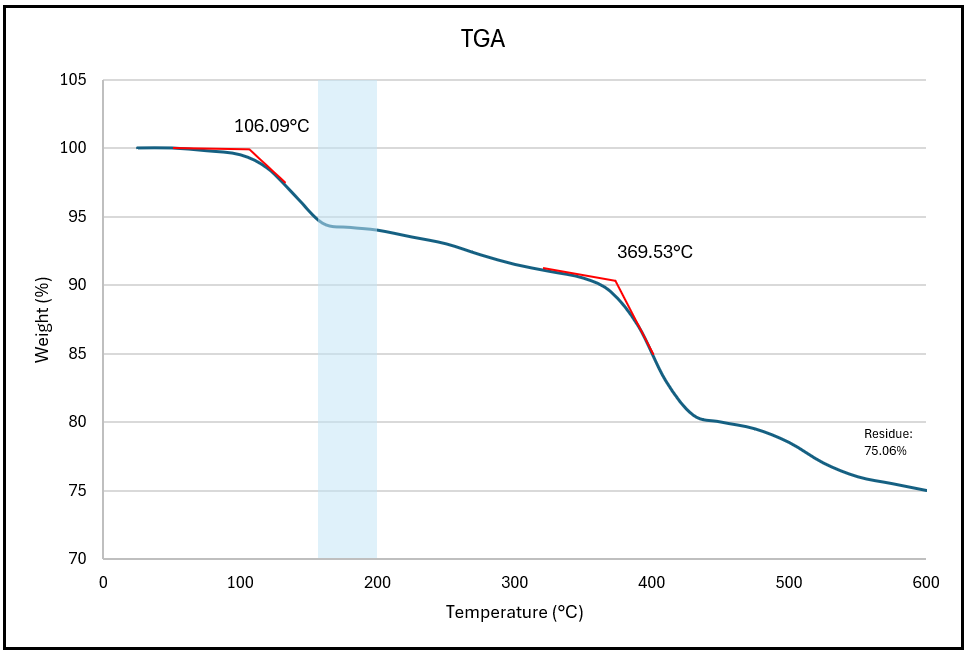
Loctite ECCOBOND FP4470 is a solvent-less epoxy. It contains 75% filler and the rest are epoxy resin and hardener systems. Thermogravimetric Analysis (TGA) graph below shows approximately (5-6%) that evaporate from the system during the curing process. This minor weight loss is typically attributed to trace residual moisture, very low levels of entrapped air, and low molecular weight. Once full cure is achieved, no more volatiles are expected to be present. Likewise, TGA does not show any other distinct low-temperature mass-loss that would indicate solvent evaporation after curing process. The primary weight-loss event begins around 350 °C to 400°C that corresponds to polymer backbone decomposition. Final residue of ~75% at 600°C is consistent with a highly crosslinked, aromatic epoxy system with potential filler content.
Can I get the yield strength of FP4470?
Typically, we do not measure yield points on this style of product. The materials are relatively rigid and show very little elastic behaviour.
One way to demonstrate this is to run a die shear test. Some equipment (eg from Dage) will record & plot a stress/strain curve as the test is performed. We have not examined the plots from these specific materials, but we doubt they will show any significant elastic or plastic properties.
|
Material Property |
FP4450 |
FP4470 (CB0260) |
|
Color |
Black |
Grey/Black |
|
Specific Gravity |
1.77 |
1.8 |
|
Viscosity, cps (25°C 7/20) |
53000 |
42000 |
|
DSC gel onset (°C), 10°C/min ramp rate |
110/138 |
140/165 |
|
Gel Time (121°C, minutes) |
12 |
12 |
|
Pot life (25°C, days) |
3 |
>5 |
|
Shelf Life (-40°C), months |
9 |
9 |
|
Cure Time, minutes |
30/90 |
30/90 |
|
Cure Temperature, °C |
125/165 |
125/165 |
|
Container Size |
30cc |
30cc |
|
Filler Type |
Silica |
Silica |
|
Hardener Type |
Anhydride |
Anhydride |
|
Maximum Filler Size (microns) |
120 |
50 |
|
Average Filler Size (microns) |
35 |
8 |
|
CTE1 (ppm/°C) |
19 |
17 |
|
CTE2 (ppm/°C) |
72 |
64 |
|
Filler Weight (%) |
73 |
75 |
|
Tg (°C) by TMA |
159 |
148 |
|
Thermal Conductivity (W/mK) |
0.63 |
0.7 |
|
Flexural Modulus @25°C, Gpa |
10.2 |
12.7 |
|
Flexural Modulus @ 240°C, Gpa |
|
0.6 |
|
Flexural Strength @25°C, Mpa |
114 |
137 |
|
Flexural Strength @ 240°C, Mpa |
|
17 |
|
Young's Modulus (Tensile Modulus), Gpa |
13.5 |
|
|
Tensile Strength, Mpa |
62.1 |
|
|
Poisson's Ratio |
0.33 |
0.33 |
|
Elongation at break, % |
1.81 |
|
|
Moisture Uptake, % (168hrs PCT) |
0.8 |
0.5 |
|
Extractable Ionics (ppm; Na; Cl) |
2; 7 |
1; 3 |
|
Linear Shinkage (%) |
0.57 |
|
|
Shore D Harness @ RT |
|
90 |
|
Thermal Stability (TGA), 10°C/min ramp rate |
310/368 |
106 / 369 |
|
Oxygen Index |
45.5 |
49.0 |
|
Alpha Count (alpha counts/ cm2 hr) |
0.005 |
<0.001 |
|
Dielectric Constant @ 100KHz |
3.62 |
3.5 1MHz |
|
Dissipation Factor |
0.004 |
0.001 |
|
Dielectric Breakdown (V/mil) |
904.1 |
|
|
Volume Resistivity @100V, Ohm-cm |
2.18E+16 |
5E+16 |
|
Surface Resistivity @100V, Ohms |
2.57E+16 |
|
|
Flammability, 1/8" thickness |
UL94HB |
UL94HB |
|
Specific Heat J/kg-K |
1105 |
1078 |
|
Rheology @ 80°C, ps |
120 |
10 |
|
Glob Height, mm |
0.5 |
0.92 |
|
JEDEC Testability (internal) |
none |
L2A |
|
RoHS Done? |
Yes |
Yes |
No available data for Dielectric strength. According to our scientists a highly silica filled encapsulant will have a range of 20 to 40Kv/mm.
Recently viewed products
HLP 2000 | Two part Thermal potting material
- Low Viscosity
- 2.0 Thermal Conductivity
- Room temperature cure

LOCTITE ECCOBOND FP4526
- Low viscosity
- Excellent wettability
- Hi-Pb and Pb-free applications

LOCTITE ECCOBOND FP4655
- Low stress
- Fine particle filler
- Combine with FP4451

Hysol GR2710 | Gold Epoxy Mold Compound
- For conductive polymer and AO capacitors
- Excellent thin wall crack resistance
- Fast cure for automold equipment


