
Glass Repellency Treatment
Harmonization Code : 2901.10.00.00 | Acyclic hydrocarbons; Saturated

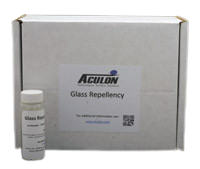
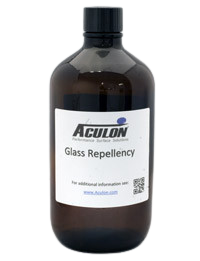


Main features
- For making glass surfaces hydrophobic and oleophobic
- 2-20 nm thickness
- Easy to apply, optically clear and ultra thin
Product Description
Aculon's glass repellency technology is designed to make glass surfaces hydrophobic, oleophobic, and repellent to nearly any liquid. Aculon's glass treatment is easy to apply, optically clear, and ultra-thin (2-20 nm). This durable treatment is designed for most glass, silicate hard-coated plastic, and ceramic parts and can be applied via several application methods, including dip, wipe, or spray.
Advantages of Aculon's Glass Repellency Treatment
- Hydrophobicity and Oleophobicity
- Repels near all liquids
- Long-lasting repellent performance
Packaging
TDS, SDS & Technical Documents
- Aculon Glass Repellency Treatment SDS
Technical Specifications
General Properties
Thermal Properties
Electrical Properties
Other Properties
Physical Properties
Additional Information
How to apply Aculon's Glass Repellency Treatment
|
STEP 1 ⇨ CLEAN |
STEP 2 ⇨ TREAT |
STEP 3 ⇨ DRY |
| Parts must be sufficiently clean before treatment for proper bonding and effective application. This can be accomplished by first degreasing the surface with solvents/rinsing with soap and water. To remove monolayer-scale contaminants, a substrate-specific cleaner is recommended based on the application. |
Dip - Fully immerse the part in the treatment solution for 1 minute. Withdraw the part at a steady rate to ensure even coverage. Allow to dry or cure depending on your substrate. |
To dry, the part should be placed at room temperature with 40-50% relative humidity for ≥24 hours. The product may also be cured for 2 hours at 150°C. Higher temperature cures create coatings with increased durability.
|
|
Wipe - Using a clean cloth apply the treatment by wiping it across the surface in a buffing motion for 1 minute per square foot. |
||
|
Spray - Spray the solution on the substrate, air dry. If the coating is too thick, reduce the amount applied by changing the settings on the spray gun or using a diluent. |
||
|
Flow - Dispense the treatment over the surface, applying enough to coat the entire surface. Allow excess material to drain, it is advised to cure for durability. |
Application Tips
- Use a microfiber cloth to wipe after cleaning.
- Coat the substrate as soon as possible after cleaning to prevent recontamination.
- Spray Equipment Suggestions: HVLP(Binks Mach 1), HVLP(Devilbiss JGHV), Air Atomization(Devilbiss MBC gun), and Airless(Graco Model 225-292 President Pump Series A).
- Cure temperatures and conditions should be optimized based on substrate and durability requirements.
How to test for Hydrophobicity
To test for hydrophobicity, allow water droplets to fall onto the surface, which should bead up to a contact angle >90⁰. If the contact angle is <90⁰, then the surface is not
hydrophobic. The surface should be cleaned again and the Glass Repellency Treatment reapplied.
Application Ideas


Recently viewed products
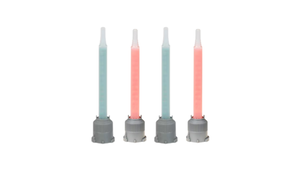
3M™ Scotch-Weld™ EPX Mixing Nozzle
- Simultaneous metering, mixing, and application in one step
- Used nozzle doubles as a cartridge storage seal between uses
- Compatible with 3M EPX manual and pneumatic applicators

VCF-4S200K | LINQSTAT 4 mil - 200,000 Ω/sq Antistatic film
- 4 mil - 100um - 0.1mm
- 200,000 ohms/sq Surface resistivity
- Not volume conductive


