TGP 5000 | Thermal Gap Pad
Harmonization Code : 3824.99.96.99 | Prepared binders for foundry moulds or cores; chemical products and preparations of the chemical or allied industries (including those consisting of mixtures of natural products), not elsewhere specified or included : Other : Other: Other

Main features
- 0.3 Thermal Impedance
- 5.0 Thermal Conductivity
- Good elastic modulus
Product Description
Honeywell's TGP5000 Thermal Gap Pads (TGP) stand right in the middle of our Thermal gap pad portfolio. The ratio of performance and cost is tightly balanced and the product's properties provide high thermal performance with ease of use across a multitude of applications. Their ultra-high compressibility enables low stress and excellent conformity to mating surfaces. They are designed to minimize thermal resistance at interfaces, and maintain excellent performance through reliability testing.
Honeywell's TGP5000 is naturally tacky, with a very good elastic modulus, and requires no additional adhesive which could inhibit thermal performance. Products have very low hardness and are available in a thickness range from 0.5mm to 5.0mm.
TGP5000
Unlike other products we offer, the products listed on this page cannot currently be ordered directly from the website.
 Shipping in 16 weeks
Packaging
TDS, SDS & Technical Documents
- Honeywell TGP5000 SDS
- TGP1200-TGP8000TDS191016
- AppNotePad-R1-6
- CAPLINQ Honeywell Thermal Interface Material Gap Filler Troubleshooting Guide
Technical Specifications
General Properties
Thermal Properties
Electrical Properties
Additional Information
Are there thermal interface materials that also have EMI shielding?
It is very challenging to formulate a high TC, 5 W/m.K TIM, which also performs well as an EMI shielding ( or absorber).
Thermal Conductivity and EMI are achieved by fillers inside the formulation. Fillers that provide good EMI lead to low thermal conductivity and vice versa. So it is not easy to satisfy both as a 2 in 1 solution.
To add to that, EMI performance is directly related to the frequency of the application. For example, it is easier to achieve good EMI shielding at high-frequency applications, like base stations in telecom, while it is difficult to achieve it at 2.5G Hz to 4 G Hz, which is at a lower frequency. All these need to be taken into account before we can properly answer this question.
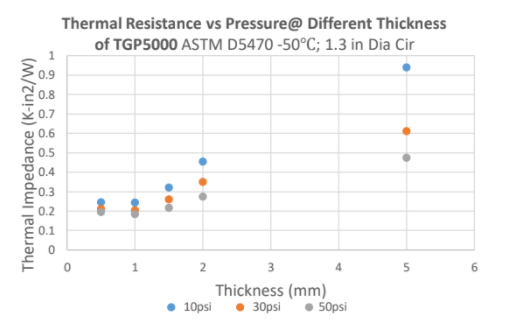
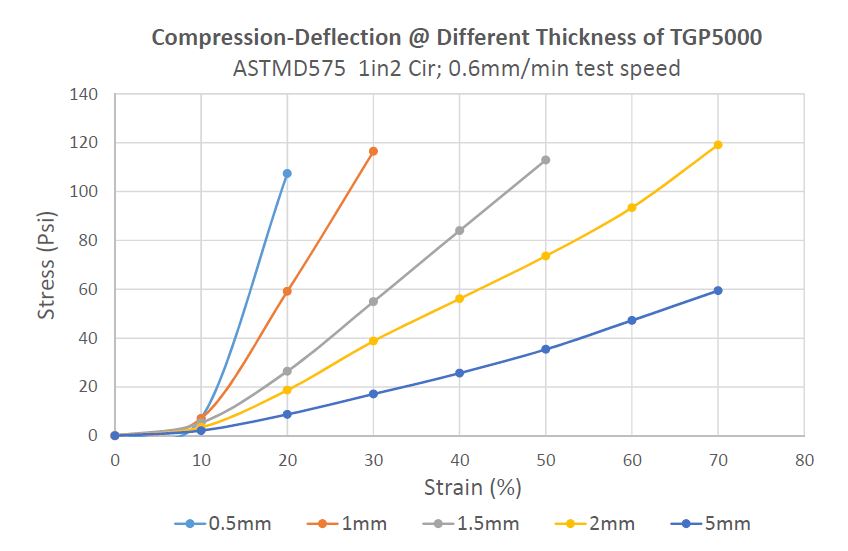
Thickness range:
- 0.5-5.0mm with 0.25mm incremental
Thickness Tolerance: >1mm, ±10%
- 0.5-1mm, ±0.1mm
- <0.5mm, ±0.05mm