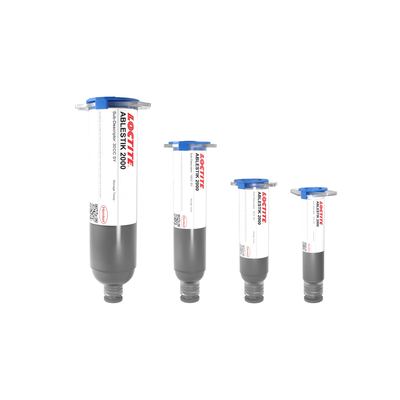
LOCTITE ABLESTIK 2000B
Harmonization Code : 3506.91.90.99 | Prepared glues and other prepared adhesives, not elsewhere specified or included; products suitable for use as glues or adhesives, put up for retail sale as glues or adhesives, not exceeding a net weight of 1 kg ; Adhesives based on polymers of headings 3901 to 3913 or on rubber; Other ; Other
Main features
- Pb free applications
- High hot/wet adhesion
- Ultra low moisture absorption
Product Description
LOCTITE® ABLESTIK 2000B electrically conductive die attach adhesive is designed for Pb-free PBGA and Array BGA packaging. This product is able to withstand the high reflow temperatures necessary for Pb-free solders @ 260°C. It is suitable for die sizes up to 12.7 x 12.7 mm.
LOCTITE® ABLESTIK 2000B is a low stress, silver filled hybrid that cures fast with no voids and with minimal resin bleed. It is a die attach material with an ultra low moisture absorption. This is mostly used in Asian regions while LOCTITE ABLESTIK 2100A is the most common choice for the EMEA region.
Cure Schedule
- 30 minute ramp to 175°C + 15 minutes @ 175°C
2000B
Unlike other products we offer, the products listed on this page cannot currently be ordered directly from the website.
 Shipping in 30 days
 Shipping in 12 weeks
 Shipping in 12 weeks
Packaging
TDS, SDS & Technical Documents
- ABLESTIK 2000B-EN
- 1200878_MSDS_UT_US_EN
Technical Specifications
General Properties
Thermal Properties
Electrical Properties
Chemical Properties
Physical Properties
Additional Information
Loctite Ablestik 2100A is a product that is an almost direct alternative to Loctite Ablestik 2000B.
Loctite Ablestik 2000B is also a conductive die attach for laminates that it is mainly used in Asian regions. For EMEA we have successfully used 2100A as a drop in for use in BGA laminate applications with great success rates.
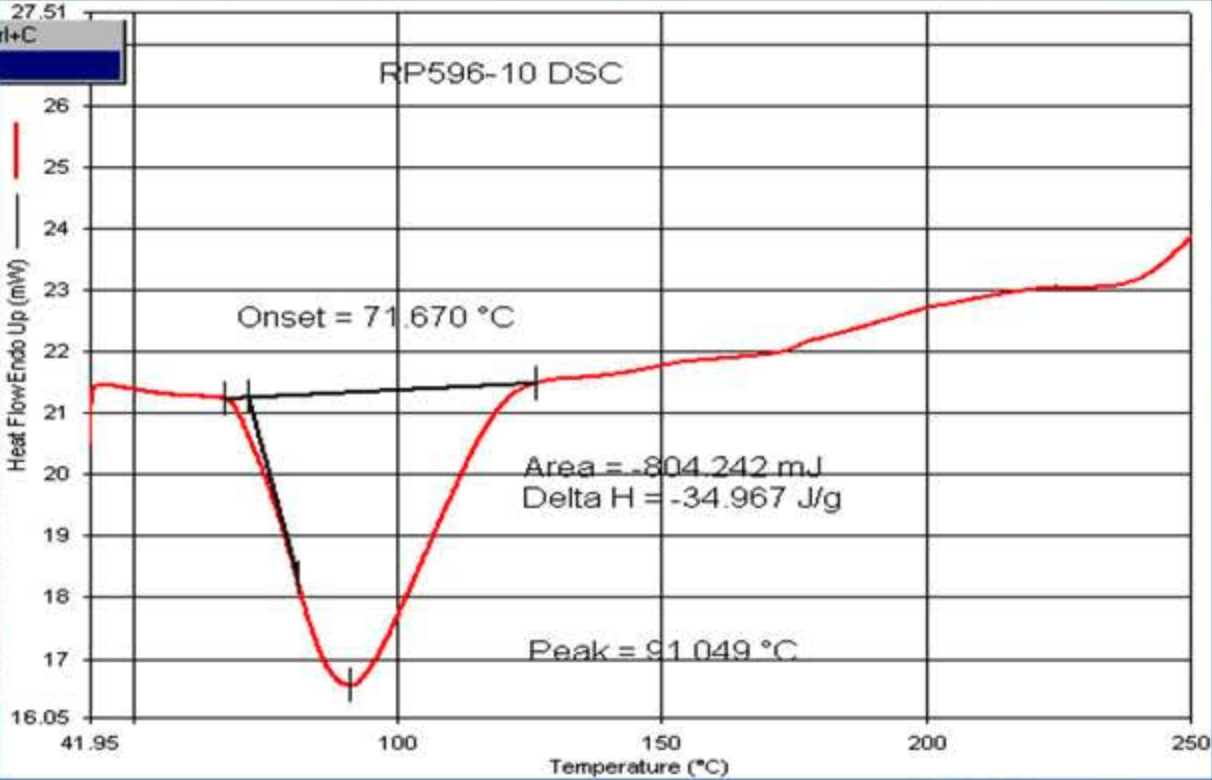
Ablestik 2100A DSC Curve - Heat flow vs temperature
Notice how the Onset of cure (minimum cure temperature) is about 70°C. Even though we suggest curing at 175°C, as with all products you can adjust the cure schedule (with a lot of trial, error and personal work) according to your final application properties.
The volume resistivity may be reduced when curing below 175°C (compared to the TDS value), but we expect that some conductivity will be developed.