
ALPHA PoP707 Lead-Free No-Clean Solder Paste
Harmonization Code : 3810.90.90 | Fluxes and other auxiliary preparations for soldering, brazing, welding
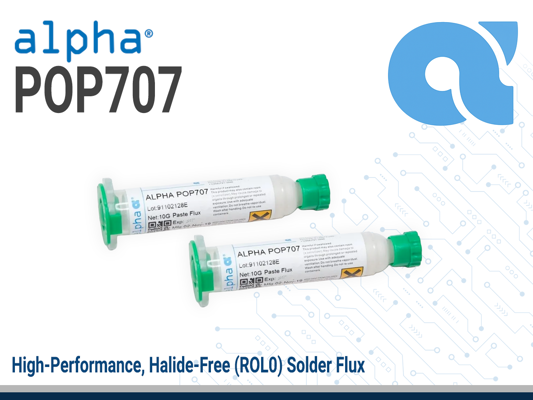
Main features
- Fine particle dispersion (<10 µm)
- ROL0 per IPC J‑STD‑004
- Outstanding SIR performance
Product Description
ALPHA PoP‑707 Paste Flux is a high‑performance, halide‑free (ROL0) electronics‑grade paste flux engineered to deliver excellent tack strength, solderability, and electrical reliability in precision assembly applications. The smooth, fine‑particle formulation provides stable viscosity, consistent component retention, and uniform flux distribution, making it well suited for fine‑pitch and sensitive electronic assemblies.
Designed for no‑clean or un‑cleaned operation, ALPHA PoP‑707 demonstrates outstanding Surface Insulation Resistance (SIR) performance under both IPC J‑STD‑004 and Bellcore testing, ensuring long‑term electrical reliability even when residues remain on the assembly. Its non‑corrosive behavior, low moisture content, and controlled acidity support robust soldering performance while safeguarding component and substrate integrity.
Product Key Features
- Smooth, white to off‑white paste flux with fine particle dispersion (<10 µm)
- Halide‑free formulation; ROL0 per IPC J‑STD‑004
- Passes IPC copper mirror and copper corrosion tests
- Outstanding SIR performance, even in un‑cleaned conditions
Applications
- SMT component placement and retention
- Fine‑pitch and densely populated assemblies
Packaging
TDS, SDS & Technical Documents
- alpha_pop-707_paste_flux_TDS
Technical Specifications
General Properties
Physical Properties
Additional Information
Cleaning
Although designed as a no clean flux system, the reflowed residue may be cleaned with BIOACT SC10E or BIOACT SC30. Production stencils or pin transfer equipment can be cleaned with BIOACT SC10.
Reflow Profiles
Reflow can be accomplished in dry air or nitrogen controlled atmosphere. The initial ramp rate should be 1 to 2 °C per second. If necessary, a dwell of 1 to 2 minutes at 130 to 160 °C is acceptable. Following this equilibrating period is a ramp of 60 to 120 °C to a peak temperature of 235 to 260 °C depending upon alloy. The time over alloy liquidus should be 45 - 90 seconds. Cooling rate should be 3 to 7 °C per second to room temperature.
Recently viewed products

HumiSeal Thinner 999
- Optimized viscosity control
- RoHS compliant
- High-purity solvent blend
Aculon Nanoproof 3-02
- 2% Fluoroacrylate Solids
- 0-2 - 2 um Thickness
- 3M Novec 1700, 1902 replacement

FM-0421 | Reactive PDMS - Monoterminal Hydroxy
- Mono terminal
- 5,000 g/mol | 70 mPas
- Hydroxy functional group
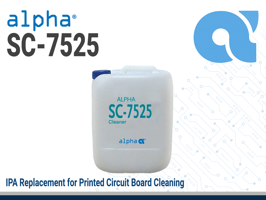
ALPHA SC-7525 Cleaner
- IPA alternative
- High solvency
- Suitable for manual & immersive methods

ABchimie 6025UV LED Soft Thixotropic Resin
- One component
- UV LED Cure
- Shock Absorbing
3M™ Scotch-Weld™ Epoxy Adhesive 7240 FR
- Long open time for large surface application
- Non-sag properties
- Contains glass beads for thickness control
OPTOLINQ TMC-3282SF | Transparent Mold Compound
- Exceptional moldability with long spiral flow
- Excellent performance at high temperature and high humidity conditions
- Excellent adhesion and low stress


