
LOCTITE ECCOBOND EN 3838T
Harmonization Code : 3907.30.00.85 | Polyacetals, other polyethers and epoxide resins, in primary forms; polycarbonates, alkyd resins, polyallyl esters and other polyesters, in primary forms : Epoxide resins : Other
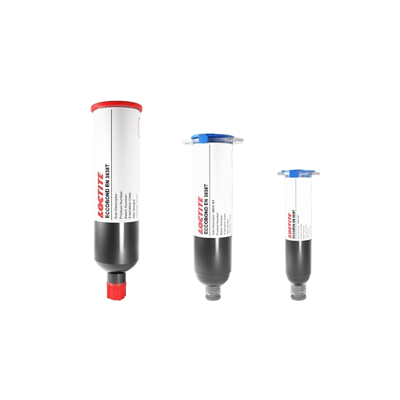
Main features
- PCB Coating
- Very Low Tg
- Fast cure at 130°C
Product Description
LOCTITE ECCOBOND EN 3838T is a black epoxy encapsulant that is designed to provide a flexible, low Tg material for encapsulating components on a PCB. When cured, this material provides physical protection and stable electronic performance and protection in temperature/humidity/bias testing.
LOCTITE ECCOBOND EN 3838T is a single component, reworkable, heat curable PCB coating that cures fast at moderate temperatures and is typically used for CPG and BGA lead free applications.
Cure Schedule
- 8 minutes @ 130°C
EN3838T
Unlike other products we offer, the products listed on this page cannot currently be ordered directly from the website.
 Shipping in 50 days
 Shipping in 12 weeks
 Shipping in 45 days
Packaging
TDS, SDS & Technical Documents
- ECCOBOND EN 3838T-EN
- LOCTITE ECCOBOND EN 3838T 55CC NL-MSDS_UT_NL
- LOCTITE ECCOBOND EN 3838T 55CC NL-MSDS_UT_EN
Technical Specifications
General Properties
Thermal Properties
Physical Properties
Additional Information
What are the differences between EN 3838T and 8387B?
Both 3838T & 8387B have a rather high thixotropic index and this indicates a low amount of self-leveling (the viscosity at low shear rates is too high to allow the material to move under its own weight). When we compare the viscosity data on TDSs, we see that they are measured using different spindles and at different rotation speeds. The reason for this is, that 8387B is developed for smaller deposits in die attach and sensor bonding applications (less weight to move the product), while 3838T is developed for larger deposits with higher thixotropy to prevent running out. Based on the viscosity data, we see that ‘viscosity almost at rest’ of 3838T is higher than 8387B :
- 8387B has 9500 cPs @ 5rpm and TI >4.5 (so ~45000 cPs @ 0,5rpm)
- 3838T has 6700 cPs @ 20rpm and TI of 5.8 (so ~40000 cPs @ 2rpm and much higher at lower rpm)
One way to reduce the viscosity (at all shear rates) is to increase the temperature of the product and or substrate. Warming to ~40C will give a big difference in viscosity (every 10 °C double or half). Going much higher in temperature could give some gelling, but customers should establish the best temperature by experiment.
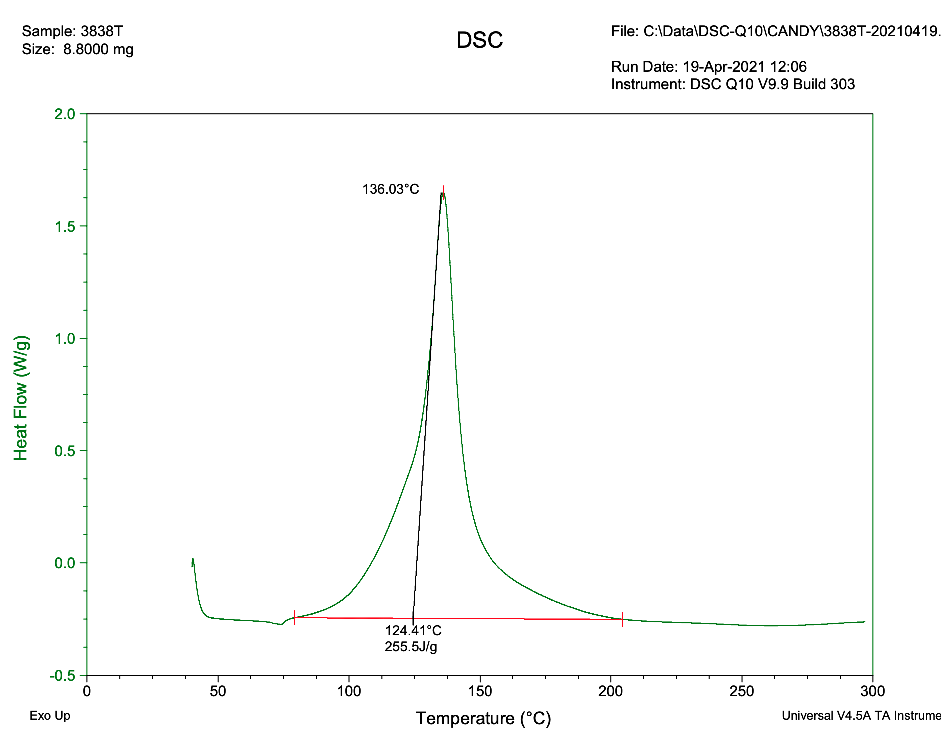
LOCTITE ABLESTIK 3838T should be able to cure, based on this DSC curve, at around ~110°C (lower than that can be risky). A starting cure time can be 30 min but we advise to optimise it for your requirements.
Recently viewed products
LOCTITE ABLESTIK ABP 8068TB
- Good workability
- High thermal stability
- Solder replacement
LINQALLOY SP-SAC307 | Solder paste
- Sn99Ag0.3Cu0.7 Alloy
- 217 - 228°C
- Powder size: T3, T4 and T5
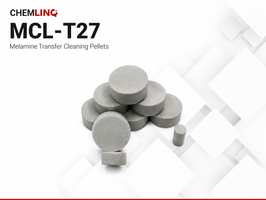
MCL-T27 | Melamine Transfer Cleaning Pellets
- Enhanced workability
- Surface restoration
- Operational efficiency

Hysol KL1000-3A | Black Epoxy Mold Compound
- Lowest Cost of Ownership
- Excellent Moldability
- Designed for ZIP, SIL, DIP packages

ABchimie R12230 Optically Clear Encapsulation Gel
- Optically clear
- Quick setting
- Good heat stability


