
DOWSIL™ TC-2035 Thermally Conductive Adhesive
Harmonization Code : 3910.00.00.90 | Silicones in Primary Forms; Others
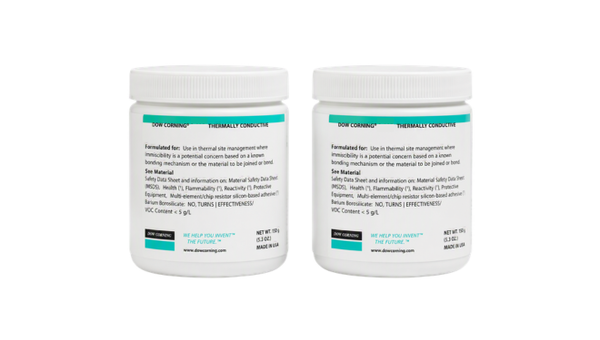
Main features
- 3.3 W/m·K thermal conductivity
- Ultra-thin bondline thickness
- Low volatile content
Product Description
DOWSIL™ TC-2035 CV Adhesive is a two-part, heat-curable silicone thermal adhesive engineered for demanding automotive and power electronics applications requiring both reliable bonding and efficient heat dissipation. Delivering 3.3 W/m·K thermal conductivity, ultra-thin bondlines down to ≤95 μm, and low volatile content below 0.01% (D4-D10), TC-2035 CV is designed to maximize thermal transfer between substrates and heat sinks while maintaining long-term mechanical and adhesive reliability. The material develops primerless adhesion to many metals, ceramics, epoxy laminates, and filled plastics, while its elastomeric silicone chemistry provides stress relief against thermal cycling, vibration, and coefficient-of-expansion mismatch. Typical applications include bonding PCB, HDI, and DBC substrates to heat sinks in ADAS modules, ECUs, power electronics, inverters, converters, and on-board chargers.
Product Key Features
- 3.3 W/m·K thermal conductivity
- Ultra-thin bondline thickness ≤95 μm
- Low volatile content (<100 ppm D4-D10)
- High-temperature stability up to 200°C
- Excellent thermal performance at various bondline thicknesses
- Mechanical reliability after accelerated aging
- Adhesion stable or improved after aging
- Excellent dielectric properties
- Primerless adhesion to selected substrates
- Two-part 1:1 mix ratio
- 15-minute cure at 115°C
- 3.5-hour pot life at room temperature
- Suitable for automotive and power electronics applications
DS-TC2035
Unlike other products we offer, the products listed on this page cannot currently be ordered directly from the website.
 Shipping in 5 weeks
Packaging
TDS, SDS & Technical Documents
- 11-4227-01-dowsil-tc-2035-cv-adhesive
Technical Specifications
General Properties
Mechanical Properties
Physical Properties
Electrical Properties
Thermal Properties
Additional Information
DOWSIL™ TC-2035 CV: Thermally Conductive Adhesive for Automotive Power Electronics
DOWSIL™ TC-2035 CV Adhesive is a two-part, heat-curable silicone thermally conductive adhesive designed for demanding electronics and automotive power module applications where long-term bonding, efficient thermal flow, and low bondline thickness are required. With 3.3 W/m·K thermal conductivity, minimum bondline thickness of ≤95 µm, excellent dielectric properties, and low volatile content, TC-2035 CV helps improve heat transfer between PCB, HDI, or DBC substrates and heat sinks in compact, high-power electronic assemblies.
High thermal performance for thin bondlines — TC-2035 CV delivers 3.3 W/m·K thermal conductivity with low bondline capability, helping reduce thermal resistance in power-dense electronics.
The elastomeric silicone chemistry provides stress relief against thermal cycling, vibration, and coefficient-of-thermal-expansion mismatch, while maintaining stable performance at elevated temperatures up to 200 °C.
Engineered for automotive electronics reliability — suitable for ADAS modules, ECU assemblies, power electronics, converters, inverters, on-board chargers, and substrate-to-heat-sink bonding.
As vehicle electronics become smaller and more powerful, TC-2035 CV helps create a thin, reliable, thermally conductive bond path between heat-generating substrates and thermal management hardware.
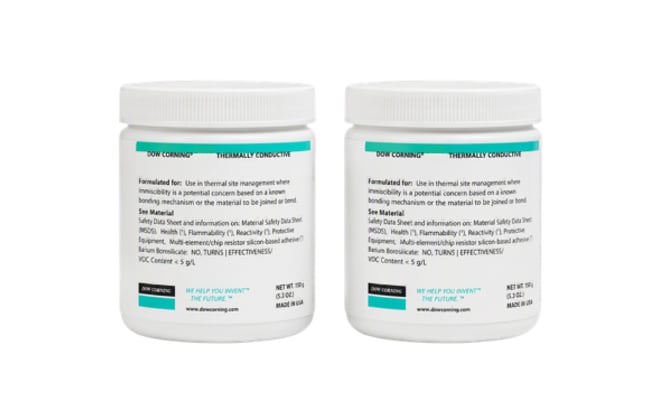
3.3 W/m·K Thermal Conductivity • ≤95 µm BLT • Low Volatile Content • Stable up to 200 °C
Features & Benefits
- High thermal conductivity — 3.3 W/m·K for efficient heat dissipation.
- Low bondline thickness — minimum BLT of ≤95 µm.
- Low volatile content — D4-D10 content below 0.01%.
- High-temperature stability — stable performance up to 200 °C.
- Primerless adhesion — bonds to selected metals, ceramics, laminates, and filled plastics.
- Mechanical reliability — maintains elastomeric properties after accelerated aging.
- Excellent dielectric properties — suitable for electronic and power module assemblies.
- 1:1 mix ratio — convenient two-part processing by weight or volume.
Typical Applications
- ADAS module assembly.
- Electronic control unit, or ECU, assembly.
- Power electronics thermal management.
- Converter and inverter modules.
- On-board charger, or OBC, assemblies.
- PCB, HDI, and DBC substrate bonding to heat sinks.
- Transmission, power, and conversion modules.
Thermal Challenges in Power-Dense Automotive Modules
Automotive electronics such as ADAS controllers, ECUs, inverters, converters, and on-board chargers require materials that can provide efficient thermal transfer while maintaining durable bonding through vibration, thermal cycling, and long-term high-temperature exposure. DOWSIL™ TC-2035 CV helps address these challenges with a high-conductivity silicone adhesive that enables thin bondlines, stable dielectric performance, and reliable adhesion between organic or ceramic substrates and heat sinks.
Engineering Data for DOWSIL™ TC-2035 CV
| Property | DOWSIL™ TC-2035 CV | Condition / Note |
|---|---|---|
| Chemistry / Type | Two-part silicone adhesive | Heat-curable system |
| Color | Part A: White Part B: Reddish brown |
Typical appearance |
| Density | 3.0 g/cm³ | Part A and Part B |
| Mix Ratio | 1:1 | By weight or volume |
| Thermal Conductivity | 3.3 W/m·K | Transient method |
| Minimum Bondline Thickness | ≤95 µm | Low BLT thermal interface |
| Heat Cure Time | 15 minutes | At 115 °C |
| Pot Life | 3.5 hours | At 25 °C |
| Hardness | Shore D 33 | Cured material |
| Tensile Strength | 3.7 MPa | Typical value |
| Elongation | 50% | Stress-relieving silicone behavior |
| Lap Shear Adhesion | 2.9 MPa | Anodized aluminum A5052P; cohesive failure ≥90% |
| Dielectric Strength | 22 kV/mm | At 1 mm |
| Linear CTE | 93.6 ppm/K | -50 to 200 °C |
*Typical properties are not intended for specification writing. Verify performance under actual application, substrate, process, and reliability conditions.
Where DOWSIL™ TC-2035 CV Fits
- ADAS control units
- ECU housings
- High-power PCB modules
- Power modules
- Transmission modules
- Conversion modules
- Inverters
- DC-DC converters
- On-board chargers
Mixing, Dispensing & Cure
Mixing
Mix Part A and Part B at a 1:1 ratio by weight or volume. Light-colored streaks or marbling indicate inadequate mixing.
Dispensing
Automated airless dispensing can help reduce voids and improve consistency. If de-airing is required, vacuum de-airing may be used until bubbling subsides.
Curing
Recommended heat cure is 15 minutes at 115 °C. For thicker or highly confined sections, a pre-cure at 70 °C may help reduce voids.
How TC-2035 CV Supports Automotive Electronic Design
| Design Challenge | DOWSIL™ TC-2035 CV Benefit |
|---|---|
| High power density creates localized heat in compact modules. | 3.3 W/m·K thermal conductivity supports efficient heat dissipation to heat sinks or housings. |
| Thick adhesive layers can increase thermal resistance. | Low bondline thickness capability helps enhance thermal transfer. |
| Automotive assemblies experience vibration, cycling, and CTE mismatch. | Elastomeric silicone chemistry helps relieve mechanical and thermal stress. |
| Sensitive electronics require dielectric reliability and contamination control. | Excellent dielectric properties and low volatile content support long-term module reliability. |
Tips & Troubleshooting
| Issue | Recommended Action |
|---|---|
| Inadequate Mixing |
|
| Voids in Cured Adhesive |
|
| Insufficient Adhesion |
|
| Thermal Performance Below Target |
|
Technical Help for Automotive Electronics Thermal Management
- Review dispense strategy and equipment compatibility.
- Assess mix ratio, de-airing, and pot life requirements.
- Support cure profile development for production assemblies.
- Evaluate PCB, HDI, DBC, and heat sink bonding requirements.
- Review substrate compatibility and adhesion risk.
- Discuss BLT, thermal resistance, dielectric, and reliability targets.
Thermal Adhesives for Next-Generation Automotive Electronics
Ready to Evaluate DOWSIL™ TC-2035 CV?
```
Recently viewed products

PIT1S-ESD-DCD | 1 mil Die Cut ESD Polyimide (Kapton) Tape with Silicone Adhesive | Single side Discs
- 1 mil polyimide film
- Single side Silicone adhesive
- >6500V breakdown voltage

DetecTape™ H2 | 20 mil NP| Hydrogen Leak Detection
- Self fusing 20 mil tape
- Easy to install
- No perforation

Glass Repellency Treatment
- For making glass surfaces hydrophobic and oleophobic
- 2-20 nm thickness
- Easy to apply, optically clear and ultra thin
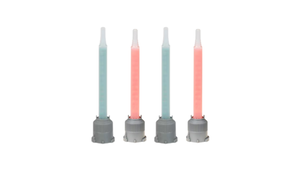
3M™ Scotch-Weld™ EPX Mixing Nozzle
- Simultaneous metering, mixing, and application in one step
- Used nozzle doubles as a cartridge storage seal between uses
- Compatible with 3M EPX manual and pneumatic applicators

VCF-4S200K | LINQSTAT 4 mil - 200,000 Ω/sq Antistatic film
- 4 mil - 100um - 0.1mm
- 200,000 ohms/sq Surface resistivity
- Not volume conductive


